
Partition Action: Ownership, Sale Authority and Proceeds
A co-owner dispute does not make a property available. Identify the interest, governing process and authority behind a proposed sale.
 By EstateHawk
On this page

Let's talk about the act of buying real estate from one angry sibling. If you listen to aggressive off-market property wholesalers on the internet, your first tip when you spot an inherited family property is almost always to get one heir under contract and use a partition lawsuit to force a court-ordered sale.
Who would have thought?
Find three quarreling heirs who inherited a house from their grandmother, convince the estranged brother who moved to Phoenix to sign a quick purchase agreement for fifty thousand dollars, and march into county court like a financial conqueror to force a public auction. Truly masterclass real estate strategy. So elegant in its simplicity. So exquisitely disastrous when the probate judge informs you that the property is protected under the Uniform Partition of Heirs Property Act, orders an independent appraisal at full retail value, allows the remaining sister to exercise a statutory right of first refusal buyout, and hits you with eighteen thousand dollars in court referee fees while deducting sixty thousand dollars of historical property tax offsets.
While we're distributing revolutionary advice, let's make sure deep-sea saturation divers remember to take off their helmets whenever they want to take a sip of coffee underwater. Let's make sure high-speed bobsled drivers remember to grease their runners with warm butter before hurtling down an Olympic ice chute.
No, "just buy out one heir and force a partition sale" is advice manufactured for fake property predators. It belongs to the guru crowd who believe that civil partition litigation is an automated legal vending machine where a judge rubber-stamps an eviction, wipes out family property rights, and hands you a multi-family property at fifty percent of market value. Those people think holding an undivided fractional interest in real estate makes them the sole king of the castle.
Here's what the real estate seminar barkers and superficial advice blogs will never explain: for an authentic real estate litigator, partition referee, or probate title examiner, dissecting a partition action isn't a casual contract play, it's an obsession they have zero control over.
If you let an authentic title obsessive anywhere near a partition filing, their brain completely disconnects from all standard conversational pleasantries. Normal people look at the property and notice the peeling exterior paint and the overgrown backyard lawn. The document obsessive could not care less about the paint. They want to know whether the concurrent ownership is structured as a tenancy in common or a joint tenancy with right of survivorship, whether the property qualifies as heirs property under New York RPAPL Article 9 or Florida Statutes Chapter 64, whether an interlocutory judgment of partition has been entered appointing an independent referee to conduct an accounting, and whether the occupying co-owner has asserted viable equitable defense claims for property tax reimbursements, insurance payments, and essential structural preservation capital.
In fact, if you leave that researcher unsupervised at two in the morning with an open browser, they won't even be reviewing court dockets at all. They will have fallen headfirst into an algorithmic rabbit hole on a Polish military vehicle restoration exchange, studying auction listings for a decommissioned Soviet BTM-3 heavy tracked high-speed trench-digging machine. They will spend two solid hours examining technical blueprints of its 400-horsepower V-12 tank diesel engine and its massive eight-bucket rotating excavation wheel, analyzing how its heavy steel crawler chassis allowed it to dig an eight-foot-deep, three-foot-wide combat trench through rocky frozen ground at eight hundred yards per hour, calculating whether its heavy dozer blade would crush an asphalt suburban roadway into dust, and reading translated forum flame wars from 2011 about whether high-pressure hydraulic hoist cylinders seize up when operated in negative thirty-degree blizzards.
Then the Instant Gratification Monkey at the back of their brain gets hit with a cold wave of pure dread. The Rational Decision-Maker kicks down the door, drags them away from Soviet high-speed combat trenchers, and slams their face back into the civil court pleadings. Because right there in the defendant's counter-claim is an equitable accounting demand for forty-two thousand dollars in historical roof repairs and structural stabilization expenses that must be deducted before a single dollar of partition sale proceeds can be disbursed.
Welcome to the intricate, emotionally charged, and strictly regulated legal arena of the Partition Action.
The foundational trap that destroys investors who attempt to buy fractional inherited interests begins with a complete failure to understand concurrent ownership.
What is a partition action?
A partition action is a statutory civil lawsuit filed in state court by a co-owner of real property to legally terminate, dissolve, and sever concurrent ownership when the co-owners cannot agree on the management, use, leasing, or sale of the property.
Notice the word: concurrent ownership.
Partition actions apply exclusively when two or more distinct legal persons or entities hold simultaneous undivided fractional interests in the same real estate, most commonly as Tenants in Common (TIC) or Joint Tenants with Right of Survivorship (JTWROS).
A partition action cannot be filed against a married couple holding title as Tenants by the Entirety.
And a partition action cannot be used to dissolve a corporation or an LLC. If a limited liability company owns an apartment building, the members do not own the real estate; the LLC owns the real estate. Disagreements among LLC members must be resolved through an action for judicial dissolution of the corporate entity under state business corporation codes, not through a real estate partition lawsuit.
Now look at the fatal delusion that snags amateur wholesalers: the illusion of the one-heir contract.
An amateur investor drives through an older neighborhood. They spot a run-down residential fourplex. They pull the county land records and discover that the property was inherited by three adult siblings following their mother's death.
The investor contacts the eldest brother, who lives in another state and has not spoken to his siblings in five years.
The brother signs a purchase agreement agreeing to "sell the property" for $150,000.
The investor celebrates. The investor believes they just bought a four-hundred-thousand-dollar property for $150,000.
The investor is living in a total legal fantasy.
Under real property law, the brother did not own the house. The brother owned an undivided one-third (33.3%) fractional interest as a tenant in common.
The brother cannot legally sell what he does not own.
The purchase contract conveys only the brother's undivided one-third interest.
The investor does not own a house. The investor is now a tenant in common with two angry, suspicious stranger siblings who own the remaining two-thirds.
The investor cannot evict the siblings. Under the common-law doctrine of unity of possession, every tenant in common has the absolute legal right to enter, occupy, and enjoy every single square inch of the real estate, regardless of the size of their fractional share.
An investor holding a one-third interest has zero legal right to change the deadbolts, kick out an occupying sibling, or force a tenant to pay rent exclusively to them.
To force a resolution, the investor is legally forced to hire a civil litigation attorney and file a formal, expensive partition lawsuit in county court.
Now consider the three distinct legal outcomes of a partition action under state law:
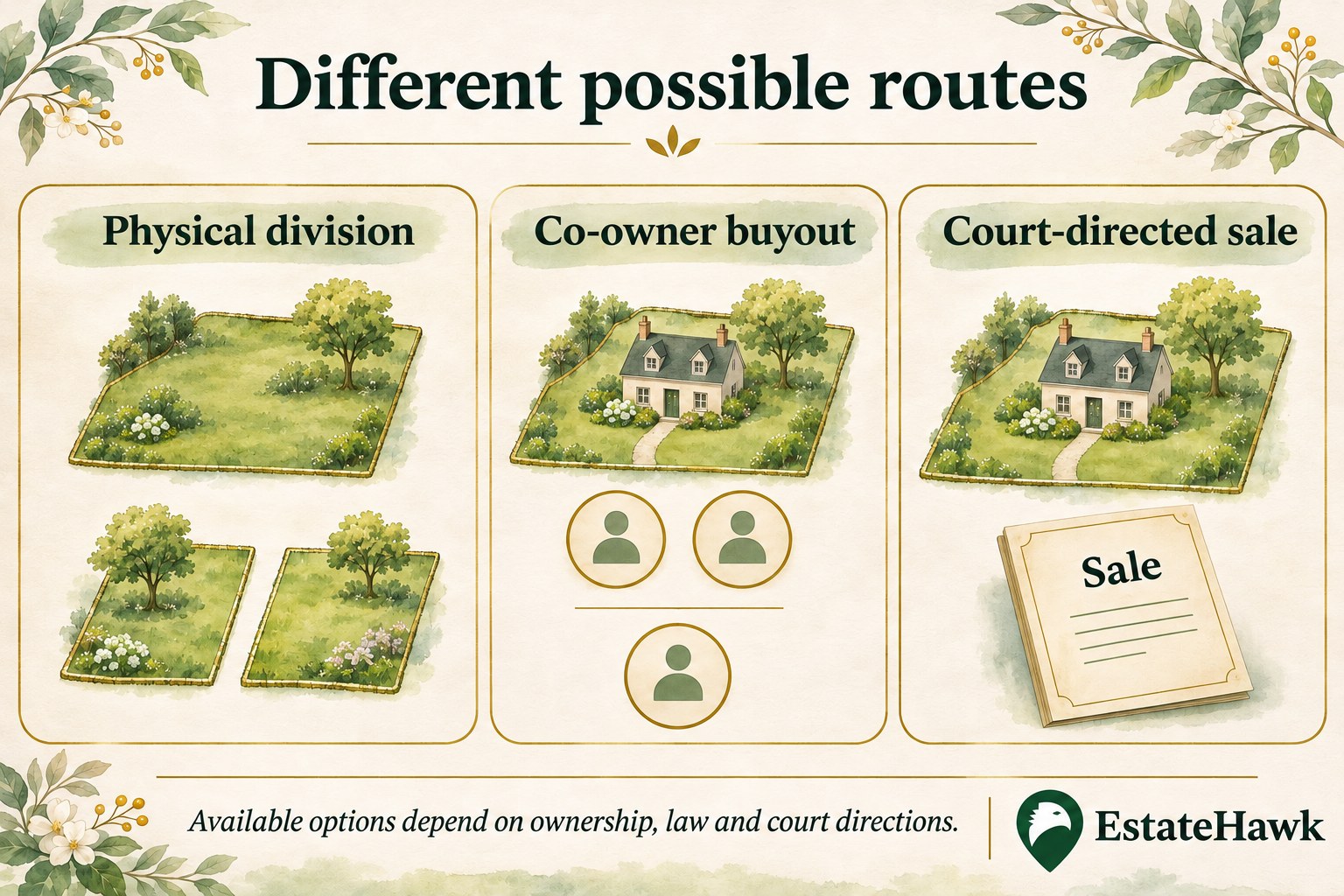
Outcome number one is Partition in Kind, commonly known as physical division.
In a partition in kind, the court physically carves the real estate into distinct, independent parcels and awards a separate, individually owned parcel to each co-owner.
Partition in kind is the historic preference of the common law. However, in the modern real estate world, partition in kind is virtually impossible for improved residential or commercial real estate.
You cannot draw a line down the middle of a single-family house and give the kitchen to the brother and the living room to the sister. You cannot divide a commercial retail building in half without destroying its economic utility, violating municipal zoning setback ordinances, and breaching minimum subdivision lot-size rules.
Partition in kind is practically limited to large rural acreage, agricultural farm tracts, or vacant raw land where the soil can be surveyed into equal, buildable tracts with dedicated public road access.
Outcome number two is Partition by Appraisal or Buyout.
In a partition by buyout, the court establishes the fair market value of the real estate through certified appraisals, and allows one co-owner to purchase the fractional shares of the other co-owners in cash, keeping the property intact.
Outcome number three is Partition by Sale.
If the court determines that the physical division of the property cannot be made without great prejudice to the owners, the court enters an Interlocutory Judgment of Partition ordering the property sold at a judicial sale.
The sale is administered by a court-appointed independent partition referee, a commissioner, or in modern practice, an assigned professional real estate broker who markets the property on the open MLS.
Once the sale closes, the proceeds are placed into the court registry, and the court conducts a formal accounting to distribute the net proceeds among the co-owners according to their respective shares.
Now let us examine the legal revolution that protects family estates: the Uniform Partition of Heirs Property Act.
This is where predatory investors get completely crushed in modern courtrooms.
Historically, predatory land speculators would buy a tiny fractional interest from a vulnerable heir, file a partition action, force an immediate courthouse-step sheriff auction on short notice, and buy the entire family estate for pennies on the dollar because family members could not organize financing in time.
To eradicate this predatory abuse, the Uniform Law Commission drafted the Uniform Partition of Heirs Property Act, universally known as the UPHPA.
The UPHPA has been enacted into law across dozens of American states, including New York under RPAPL Section 993, Florida under Florida Statutes Section 64.201 through 64.214, California under Code of Civil Procedure Section 874.311, and across the South.
If real estate qualifies as heirs property, which means concurrent ownership where at least one owner acquired their interest from a relative through probate or intestate succession, the UPHPA completely strips predatory investors of their traditional advantages:
First, mandatory independent court appraisal. The court will not accept an investor's lowball valuation. The court appoints an independent, state-certified appraiser to determine the true, unencumbered fair market value of the entire property.
Second, mandatory statutory buyout rights. Once the court establishes the fair market value, the remaining family co-owners have an absolute statutory right of first refusal to purchase the petitioner's fractional interest at that appraised value. The investor cannot force an auction if the family elects to buy them out.
Third, open-market brokerage sales. If an auction is required because no co-owner exercises a buyout, the court mandates that the property must be listed with a licensed real estate broker on the open Multiple Listing Service at full market price for a reasonable commercial period, completely eliminating below-market courthouse-step clearance auctions.
Now consider the financial accounting phase: why gross sale price does not equal net cash proceeds.
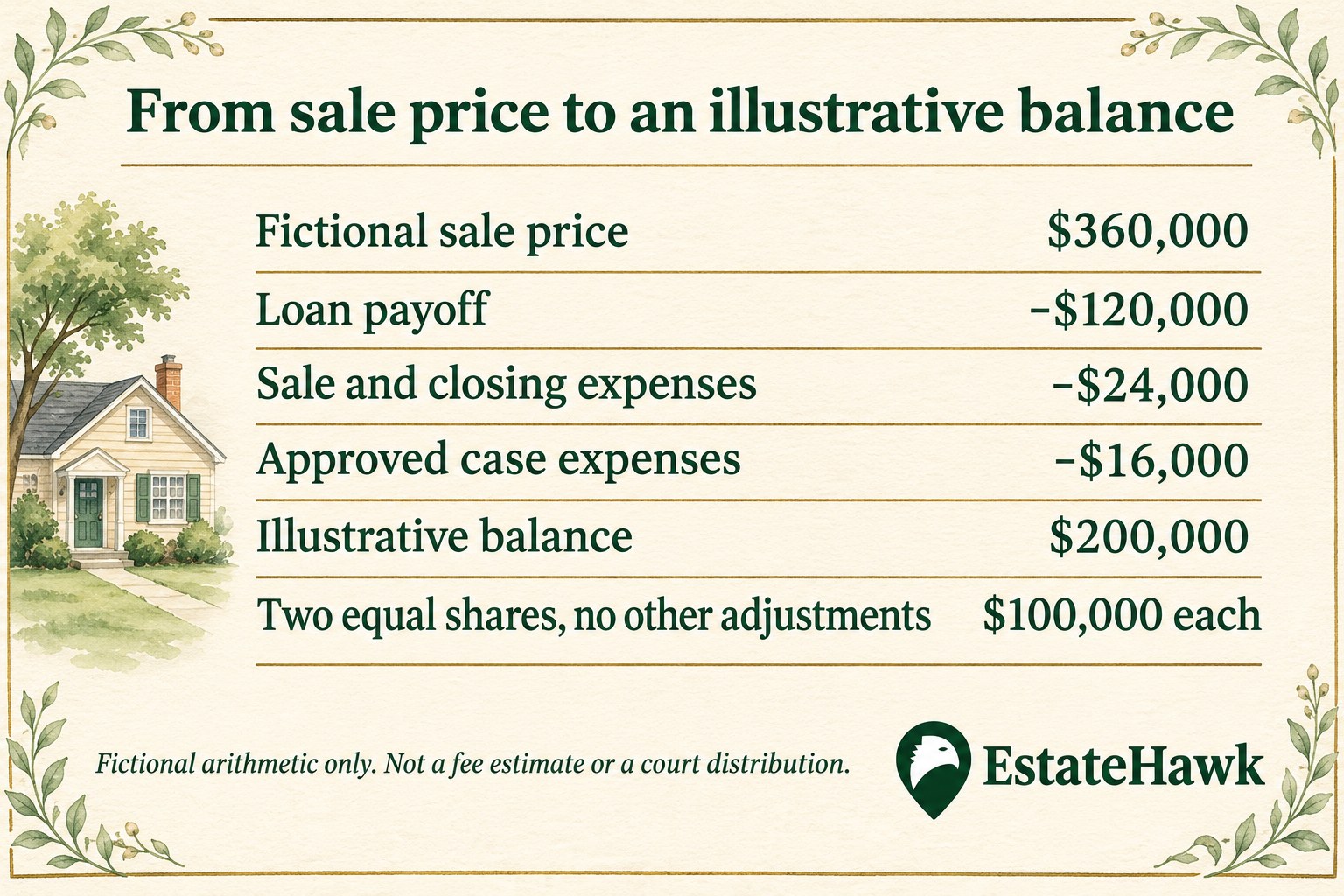
Amateur investors look at a partition property, estimate a sale price of $360,000, divide by two co-owners, and assume they will receive a check for $180,000.
That is an absolute mathematical delusion.
Before a single dollar reaches the co-owners, the court deducts all senior liens, transactional fees, and litigation expenses:
Let us examine a realistic partition accounting cascade:
Gross Property Sale Price: $360,000.
First deduction: Existing senior mortgage payoff. If the property carries a recorded deed of trust, that bank must be paid off in full on closing day: $120,000.
Second deduction: Commercial sale and closing expenses. Real estate brokerage commissions, title search fees, owner's title insurance policies, escrow fees, and county documentary transfer taxes: $24,000.
Third deduction: Court-ordered partition case expenses. The court-appointed partition referee fees, independent appraiser fees, title abstract costs, and statutory attorney fees awarded by the judge: $16,000.
Now calculate the true net proceeds remaining in the court registry:
$360,000 gross price minus $120,000 mortgage minus $24,000 closing costs minus $16,000 court referee fees.
True Net Distributable Proceeds: $200,000.
In an idealized fifty-fifty split with zero disputes, each co-owner would receive $100,000.
However, partition litigation rarely involves zero disputes.
This brings us to the equitable accounting offsets: taxes, repairs, and ouster claims.
In a partition action, the judge conducts an equitable accounting of historical contributions:
If Co-Owner A lived out of state and paid zero expenses, while Co-Owner B resided on the property and spent forty thousand dollars over ten years paying county property taxes, building insurance, and replacing a leaking roof to preserve the physical structure, Co-Owner B is legally entitled to a contribution credit.
The judge will deduct Co-Owner A's proportionate share of those preservation expenses from Co-Owner A's distribution check and award it directly to Co-Owner B.
Furthermore, if Co-Owner B physically locked out Co-Owner A, changed the deadbolts, and refused to allow Co-Owner A onto the property, Co-Owner A can assert a legal claim of ouster, demanding a credit for the fair market rental value of the property for the entire period of wrongful exclusion.
These accounting battles routinely consume tens of thousands of dollars in expert witness fees and legal discovery, eating away the equity before the final distribution order is entered.
Let us walk through an educational case study that demonstrates how an aggressive investor was destroyed in a partition action.
Consider an investor named Ethan who identifies a four-bedroom residential home on Oakridge Boulevard. The home was owned by an elderly woman who passed away without a will. Under state intestate succession laws, legal title passed equally to her two adult children: a son named David and a daughter named Sarah.
Sarah lives in the home, maintains the yard, and pays the property taxes. David lives across the country, is unemployed, and wants immediate cash.
Ethan contacts David. Ethan convinces David to sell his undivided fifty percent tenant-in-common interest to Ethan for $50,000 in cash.
David signs a quitclaim deed. Ethan records the deed.
Ethan believes he just engineered a financial masterpiece. He knows the house is worth $320,000. He tells himself: "I will file a partition action, force a court auction, buy Sarah's half for pennies on the dollar, and walk away with a two-hundred-thousand-dollar profit!"
Ethan hires an aggressive litigation attorney and files a formal Partition Action against Sarah in county court.
Ethan's nightmare begins immediately.
Sarah hires an experienced probate and real estate litigator.
First, Sarah's attorney files an answer invoking the state's Uniform Partition of Heirs Property Act.
The judge orders a formal court appraisal. The court-appointed appraiser determines the fair market value of the home is $330,000.
Under the UPHPA, the judge enters an order granting Sarah a forty-five-day statutory right of first refusal to purchase Ethan's fifty percent interest at the appraised value of $165,000.
Ethan's dream of forcing a cheap auction is completely dead.
Second, Sarah's attorney files an equitable cross-claim for a historical accounting.
Sarah produces receipts proving that over the previous seven years, David paid zero expenses. Sarah paid $28,000 in delinquent county property taxes, $14,000 in homeowner insurance, and spent $18,000 replacing the entire failed plumbing system and installing a new furnace.
Total property preservation expenses: $60,000.
The judge finds that Sarah preserved the common estate and orders that Ethan, having stepped into David's shoes, is legally responsible for fifty percent of those preservation costs.
The judge awards Sarah a thirty-thousand-dollar equitable contribution offset against Ethan's share.
Third, the litigation dragged on for fourteen months. The court awards $12,000 in fees to the court-appointed referee and appraiser, allocated equally between the parties, costing Ethan an additional $6,000.
Look at the final financial reckoning when Sarah secures a bank loan to buy Ethan out:
Ethan's fifty percent appraised share: $165,000.
Minus Sarah's equitable accounting offset: $30,000.
Minus Ethan's share of court referee and appraisal fees: $6,000.
Net payout disbursed to Ethan from the court registry: $129,000.
Now look at Ethan's actual cash balance sheet:
Net cash received from court: $129,000.
Minus the initial purchase price Ethan paid to David: $50,000.
Minus Ethan's own private legal defense fees paid to his litigation attorney over fourteen months: $22,000.
Total Net Capital Gain: $57,000.
Ethan made $57,000. But to get that $57,000, Ethan had to tie up $50,000 in cash capital, pay $22,000 in legal bills, endure fourteen months of stressful civil litigation, and face the constant risk of complete capital loss.
Ethan did not buy a house for a steal. Ethan bought an expensive, high-risk equity lawsuit.
Now let us examine the four conversational questions that constantly arise whenever property buyers evaluate partition actions.
The first question involves authority: Can a single co-owner legally sell the entire property without the knowledge or consent of the other owners?
No. That is a foundational principle of property law. A single tenant in common can only sell or convey their own specific fractional interest. They have zero legal power to encumber, sell, or convey the fractional shares of the other co-owners. Conveying one hundred percent of a property requires either the voluntary, signed agreement of every single co-owner on the vesting deed, or an explicit judicial decree signed by a judge in a formal partition action. Any contract in which one heir purports to sell the entire house without authority conveys only their undivided fraction.
The second question concerns legal outcomes: Does filing a partition action guarantee that the court will order the property sold at a public auction?
Never assume that. A public auction is only one of three possible outcomes, and under modern statutes, it is the least preferred remedy. Courts first examine whether the land can be physically divided through a partition in kind. If physical division is impractical, modern statutes like the Uniform Partition of Heirs Property Act grant remaining co-owners a mandatory right of first refusal to buy out the petitioner at court-appraised fair market value. If a sale is ordered, courts overwhelmingly mandate open-market listings through licensed real estate brokers rather than distressed courthouse auctions.
The third question involves family protections: What is the specific legal purpose of the Uniform Partition of Heirs Property Act?
The Uniform Partition of Heirs Property Act was enacted specifically to protect family real estate, generational wealth, and vulnerable heirs from predatory land speculators. The statute prevents investors from acquiring a tiny fractional interest from an heir and forcing a below-market courthouse auction. It mandates certified independent court appraisals at full market value, grants family members a statutory buyout option, and requires that any forced sale be conducted on the open market through the Multiple Listing Service to maximize sales proceeds for all owners.
The fourth question addresses software: Where do modern property intelligence platforms and automated research tools fit into partition analysis?
Property intelligence software platforms are invaluable for preliminary research, allowing investors to verify historical vesting deeds, trace probate transfers, review property tax assessment histories, and identify recorded liens. However, digital software cannot evaluate family relationships, interpret complex intestate probate succession laws, draft civil court complaints, or predict judicial accounting offsets. Software data must always be paired with an experienced real estate litigation attorney, certified title abstractors, and licensed closing agencies before pursuing fractional property interests.
When you evaluate a property burdened by co-owner disputes or inherited fractional shares, approach the file with absolute legal discipline.
Never assume that an unhappy heir can deliver a clear deed. Verify the exact legal ownership structure on the recorded deed, understand the strict protections of the Uniform Partition of Heirs Property Act, account for all historical property tax and repair offsets, and never initiate litigation without a comprehensive financial and legal risk assessment.
Operating with that level of legal and procedural rigor is what protects your capital, preserves your equity, and ensures that your property acquisitions are built on enforceable legal reality rather than predatory illusions.