
Land Contract: Buyer Rights, Payment Records and the Deed
Moving in, paying monthly installments, and receiving a recorded warranty deed are entirely separate legal realities. Follow the chain of records, statutory cure protections, and payoff mechanics from signing to deed delivery.
 By EstateHawk
On this page

The act of buying real estate on a land contract: your first tip is to avoid signing an unrecorded contract for deed with an underwater seller who still owes half a million dollars to a senior commercial lender.
Who would have thought.
So elegant in its simplicity. Truly mind-shattering guidance.
While we are here, let us make sure drowning people avoid deep water, instruct pilots never to collide with mountains at cruising altitude, and remind prospective homeowners that sleeping in a house without a roof during a hail storm might lead to damp drywall.
No, "just avoid shady off-market deals" is only good advice for fake property scouts and weekend seminar gurus who think seller financing is a magical loophole where state statutes, municipal liens, and county land records politely cease to exist.
Here is what the dictionary and fake real estate influencers will never understand: for an actual title scout, verifying an installment contract is not a casual administrative checklist, it is an absolute obsession they have zero control over.
You sit down at your desk at seven in the evening, fully intending to review a standard three-page purchase agreement for a modest brick bungalow in Akron. Four minutes later, you find yourself four hours deep into a Scandinavian military surplus equipment auction, carefully analyzing the chassis specs of a 1968 Swedish Hagglunds BV206 amphibious articulated all-terrain carrier. It has twin molded rubber tracks. It is powered by a naturally aspirated Ford Cologne 2.8-liter V6 engine that puts out barely ninety-nine horsepower, yet it crawls over six-foot peat bogs and frozen Scandinavian muskeg without breaking traction. You are mentally mapping how you would drive this dual-cab amphibious beast across flooded county easements to inspect abandoned parcels in northern Michigan. You are actively scrolling through archived Finnish off-road forum threads from 2011, reading heated arguments about whether the hydraulic steering articulation cylinders blow their seals when exposed to negative thirty-degree blizzards or whether the secondary drive shaft bearing failure was merely caused by improper lithium grease applications.
The Instant Gratification Monkey was having the absolute time of his life dreaming of traversing sub-arctic tundra in a bright orange articulated tracked box. Then the Rational Decision-Maker woke up, violently slammed the laptop lid on military troop transports, and stared cold-eyed at the actual document on the screen.
Because what was sitting on that screen was not a triumphant path to homeownership. It was an unrecorded, poorly drafted land contract where the buyer had paid forty-two thousand dollars in cash installments over five years, while the seller had spent those same five years letting county property tax assessments accumulate, taking out secondary private judgment liens, and quietly defaulting on an underlying bank mortgage that was about to wipe the buyer off the face of the earth.
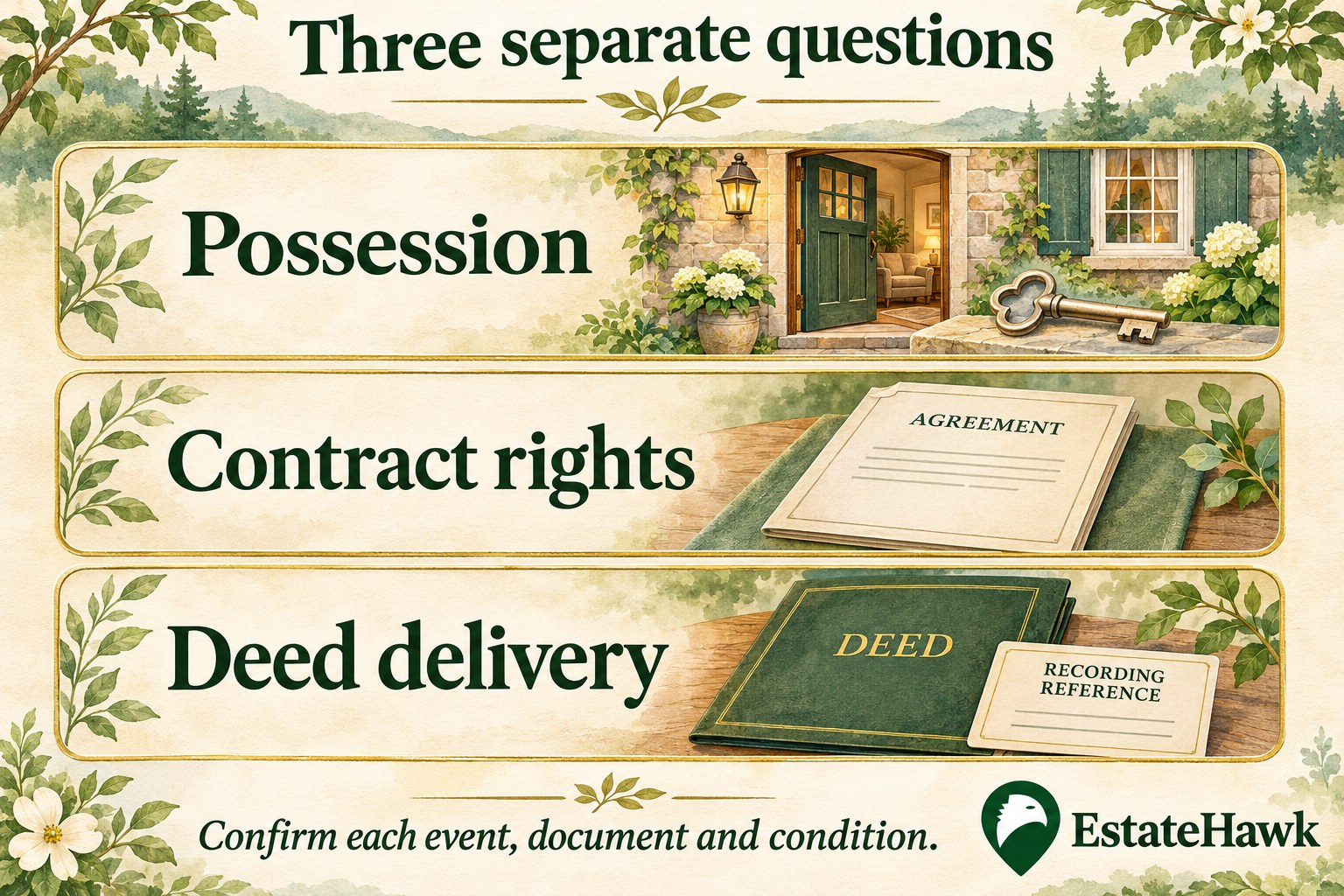
Moving in, paying monthly installments, and actually receiving legal title to real estate are three completely separate events. If you treat them as the same thing, the county sheriff and a foreclosure referee will eventually educate you on the difference at six o'clock on a Tuesday morning.
Let us dismantle how a land contract actually functions under the law, what equitable title grants you versus what legal title leaves with the seller, how state statutes divide forfeiture from foreclosure, why payment reconciliation is your only shield against total equity destruction, and how to structure deed escrow so you do not reach the final balloon payment only to discover your seller died intestate three states away.
The Fundamental Anatomy: Legal Title Versus Equitable Title
Most people grow up believing that buying real estate is a single, instantaneous transaction. You sit at a conference table, a title officer pushes a stack of papers toward you, you sign your name forty-seven times, money moves through a wire system, you receive a heavy set of brass keys, and the county recorder stamps a general warranty deed with your name in bold letters at the top.
A land contract, also known depending on your state as a contract for deed, land installment contract, bond for deed, or agreement for deed, detonates that traditional model.
In a land contract, the transaction is stretched across years, sometimes across decades. The purchase price is financed directly by the seller. Instead of securing a mortgage from a bank or credit union to deliver the full purchase price to the seller at closing, the buyer agrees to make regular monthly payments directly to the seller over an agreed term.
Here is the legal pivot that causes endless misery: the seller retains legal title to the property for the entire duration of the contract. The buyer receives what the courts define as equitable title.
Legal title is the formal ownership interest recognized on the public face of the land records. The entity holding legal title is the registered owner in the county deed registry. They hold the legal deed. They are the name on the tax rolls unless an affirmative statutory transfer affidavit has been filed. If a title examiner runs a standard forty-year chain of title without pulling recorded contracts, the legal title holder is the party that appears to own the parcel.
Equitable title, by contrast, gives the buyer the right to occupy the property, enjoy its use, and demand the delivery of legal title once every single condition and payment in the contract has been fully satisfied. Under the doctrine of equitable conversion, equity treats the buyer as the real property owner for purposes of risk, maintenance, and capital gains, while viewing the seller's interest as personal property, essentially a security interest representing the unpaid balance of the purchase price.
That sounds tidy in a first-year law school property syllabus. Out in the real world, it is a legal tightrope suspended over an active industrial shredder.
Because the seller retains legal title, third parties dealing with the seller can create devastating encumbrances. If the seller incurs an unpaid federal tax lien under Internal Revenue Code Section 6321, the IRS files a Notice of Federal Tax Lien in the county records against the legal title holder. If the seller gets sued for an auto accident and a judgment creditor records a judgment lien, that judgment attaches to the seller's legal interest in real property within the county. If the seller files for Chapter 7 or Chapter 13 bankruptcy, the land contract can be pulled into federal bankruptcy court under 11 U.S.C. Section 365 as an executory contract, subjecting the buyer's rights to the scrutiny of a bankruptcy trustee looking to maximize the debtor's estate.
Furthermore, if the buyer never records the land contract in the public land records, the buyer's equitable title is completely invisible to the outside world. An unethical seller can take out a new bank mortgage on the property, pocket the loan proceeds, and vanish. If that bank records its mortgage without actual or constructive notice of the unrecorded occupant, that bank mortgage takes priority over the buyer's unrecorded equitable interest under state recording statutes.
Equitable title is a powerful shield in a court of equity, but only if you have forged it correctly and hammered it into the public county records where no subsequent creditor can pretend they did not see it.
The Underlying Mortgage Nightmare and the Due-on-Sale Clause
Here is the silent killer hiding inside more than half of the residential land contracts drafted in America today: the property being sold on contract already has a mortgage on it.
A property owner owes two hundred thousand dollars to Wells Fargo or a local credit union. The owner decides to sell the property on a land contract to an eager buyer for two hundred and sixty thousand dollars with twenty thousand dollars down. The buyer agrees to pay two thousand dollars a month, which easily covers the seller's fifteen-hundred-dollar monthly mortgage payment. It looks like a win-win scenario in an online real estate forum.
It is actually a legal minefield.
First, virtually every residential mortgage note executed in the United States contains a standard acceleration clause known as the due-on-sale clause. Under this provision, if the borrower transfers any legal or equitable interest in the property without the lender's prior written consent, the lender has the legal right to call the entire remaining principal balance immediately due and payable.
Federal law governs this through the Garn-St. Germain Depository Institutions Act of 1982, codified at 12 U.S.C. Section 1701j-3. While the Garn-St. Germain Act carves out specific protected transfers where lenders cannot trigger due-on-sale, such as transfers to a surviving joint tenant upon death, transfers to a spouse or child, or subordinate liens that do not relate to an occupancy transfer, it explicitly does not protect installment land contracts. Entering into a land contract with an incoming occupant triggers the lender's absolute statutory right to accelerate the underlying mortgage.
Second, consider the cash flow mechanics. The buyer diligently pays their monthly installment to the seller every single month on the first. What guarantees that the seller takes that cash and forwards it to the underlying bank?
Nothing. Absolutely nothing, unless a licensed, bonded third-party loan servicing company has been legally placed between them.
If the seller experiences a financial shock, a divorce, a medical emergency, or simply decides to gamble the funds on cryptocurrency, the seller stops paying the bank. The bank does not know the buyer exists. The bank does not care that the buyer has lived in the living room for four years and meticulously planted rose bushes. The bank initiates a judicial foreclosure against the seller as the legal mortgagor. When the foreclosure judgment is entered and the sheriff's sale is scheduled, the sheriff serves an eviction notice on whoever happens to be inside the dwelling.
If the land contract was recorded after the bank's mortgage, the bank's senior lien completely extinguishes the junior equitable interest of the contract buyer at the foreclosure sale. The buyer loses every penny of their down payment, every dollar spent on repairs, and every cent paid toward principal equity over the entire life of the agreement.
If an installment sale must take place on a property with an underlying lien, it requires either lender consent, formal wraparound loan servicing where payments flow directly to the underlying note holder through an independent escrow account, or total transparent payoff of the underlying debt before contract execution. Any seller who refuses to disclose their underlying mortgage statements is not a seller financing partner; they are an eviction event waiting to happen.
State Statutory Frameworks: The Sharp Split Between Forfeiture and Foreclosure
The most critical legal battleground in land contract law is what happens when a payment is missed. This is where state laws diverge with violent intensity.
Historically, land contracts contained ruthless "forfeiture" clauses. Under common-law forfeiture, if a buyer missed a single installment by twenty-four hours, the seller could declare the entire contract null and void, terminate the buyer's equitable interest overnight, treat all prior payments as mere rent, and evict the buyer through a summary landlord-tenant proceeding. The buyer walked away with zero equity, no refund, and nowhere to live.
Because that mechanism resulted in unconscionable predatory abuse, modern state legislatures and state supreme courts stepped in. But they stepped in unevenly, creating completely different legal protections across state borders.
Ohio: The ORC Chapter 5313 Five-Year and Twenty-Percent Rule
In Ohio, land installment contracts for residential property are strictly regulated under Ohio Revised Code Chapter 5313.
Under ORC Section 5313.02, an installment contract must contain sixteen mandatory statutory elements, including the full legal description, the purchase price, the down payment, the interest rate, the principal balance, the property tax responsibilities, and an explicit provision requiring the seller to record the contract within twenty calendar days of execution. If the seller fails to record within twenty days, the buyer has the statutory right to cancel the agreement and demand a full refund of all payments made.
More importantly, Ohio ORC Section 5313.07 establishes a hard line between summary forfeiture and mandatory judicial foreclosure.
If a buyer has made payments under the contract for a period of five years or more, ORC 5313.07 strictly prohibits the seller from using forfeiture. Instead, the seller must initiate a full formal foreclosure lawsuit in the Court of Common Pleas, identical to a bank foreclosure. The property must be appraised by three independent freeholders, advertised in the local newspaper, and sold at a public sheriff's auction.
The exact same rule applies if the buyer has paid toward the purchase price an amount equal to or greater than twenty percent of the total purchase price, regardless of how long the contract has been in effect.
If either of those conditions is met, five years of payments or twenty percent of the price paid, forfeiture is legally dead. The buyer is entitled to an appraisal, a public sale, and the return of any surplus equity remaining after the seller's judgment is satisfied.
If, however, the buyer has paid for less than five years and has paid less than twenty percent of the price, Ohio allows the seller to pursue statutory forfeiture under ORC Section 5313.05 and 5313.06, but only after serving a formal thirty-day notice of default and intent to forfeit that provides the buyer thirty full calendar days to cure the default.
Michigan: MCL Chapter 565 and Summary Forfeiture Versus Foreclosure
Michigan has long been one of the highest-volume land contract states in the nation, governed under Michigan Compiled Laws Chapter 565 and Chapter 600.
In Michigan, a land contract seller has two distinct legal paths upon default: forfeiture under MCL 600.5701 et seq., or judicial foreclosure under MCL 600.3101 et seq.
If the seller chooses summary forfeiture, they serve a formal fifteen-day forfeiture notice. If the buyer does not cure, the seller files a summary proceeding in the local District Court. Under MCL 600.5744, if the court enters a judgment for possession against the buyer, Michigan law mandates a statutory redemption period.
If the buyer has paid less than fifty percent of the purchase price, the buyer has ninety days from the date of the judgment to pay the entire adjudicated arrearage, including court costs, and reinstate the contract. If the buyer has paid fifty percent or more of the purchase price, the statutory redemption period expands to six full months.
During that redemption period, the buyer cannot be evicted. If they pay the arrearage, the contract is fully restored. However, under forfeiture, the seller cannot pursue a deficiency judgment for unpaid future principal; they get the property back, and the debt is canceled.
If the seller instead chooses judicial foreclosure in Circuit Court, they can accelerate the entire remaining debt and seek a money judgment for any deficiency, but the buyer receives a mandatory six-month statutory redemption period following the sheriff's sale under MCL 600.3140.
Michigan also treats a land contract as a complete transfer of ownership for property tax purposes. Under Michigan State Tax Commission guidelines revised in February 2025, executing a land contract triggers an immediate "uncapping" of the property's taxable value under Section 27a of the General Property Tax Act (MCL 211.27a). The buyer must file Michigan Treasury Form 2766 (Property Transfer Affidavit) within forty-five days of execution, or face statutory monetary penalties. The taxable value resets to fifty percent of true cash value, often resulting in an immediate and violent spike in property taxes that the buyer was never told about.
Texas: Chapter 5 Subchapter D Executory Contracts and the Forty-Forty-Eight Protection
Texas represents the most aggressive pro-buyer land contract regime in the United States, governed by Texas Property Code Chapter 5, Subchapter D, covering executory contracts for conveyance.
Following decades of predatory contracts in unincorporated colonias along the border, Texas enacted strict consumer protections. Under Section 5.066, if a buyer defaults after having paid forty percent or more of the purchase price, or if they have made at least forty-eight monthly payments under the executory contract, the seller is legally barred from using forfeiture.
The seller must appoint an independent trustee, deliver a written sixty-day notice of cure, and conduct a formal non-judicial power-of-sale foreclosure auction in accordance with Texas Property Code Section 51.002. Any equity above the debt belongs to the buyer.
Texas also requires sellers to deliver detailed financial disclosures, property condition disclosures, and flood hazard notices before contract execution under Sections 5.069 through 5.071. Furthermore, under Texas Property Code Section 5.077, the seller must deliver an annual written accounting statement to the buyer every single January, detailing the exact amount paid in principal, the interest charged, the remaining balance, the number of payments left, and the taxes and insurance paid from escrow. If a Texas seller fails to provide this annual accounting, they face statutory damages of two hundred and fifty dollars a day.
Florida: The Unforgiving Mortgage Treatment Under F.S. Section 697.01
In Florida, the courts take an uncompromising view of installment land contracts, historically known as agreements for deed.
Under Florida Statutes Section 697.01, any instrument given for the purpose of securing the payment of money on real estate, regardless of its title, phrasing, or marketing label, is legally deemed a mortgage.
A seller in Florida cannot use summary eviction. They cannot use statutory forfeiture. They cannot cancel the contract and change the locks. If an agreement for deed buyer defaults in Florida, the seller's sole and exclusive remedy is to file a full-blown judicial mortgage foreclosure action in the Circuit Court, complete with summons, service of process, lis pendens recording, summary judgment hearings, and a formal public foreclosure auction under Florida Statutes Chapter 45.
The Mandatory Recording Imperative and the "Pocket Contract" Catastrophe
The single greatest source of catastrophic loss in seller-financed real estate is the phenomenon known as the "pocket contract."
A buyer signs a land contract on a kitchen table. The seller smiles, shakes the buyer's hand, hands over the keys, and says, "Do not worry about recording this with the county clerk. Recording it just raises your property taxes and creates unnecessary government red tape. We will just keep the original safe in our file cabinet until you make the final payment."
That is not an act of kindness. That is legal suicide for the buyer.
A pocket contract is an unrecorded instrument. While it remains binding between the original signing parties under contract law, it is completely unenforceable against subsequent bona fide purchasers or encumbrancers who acquire an interest in the property without notice.
Consider the recording statutes governing land records across the country. In a pure "race" recording state, the first party to record their document at the county registry wins priority, period. In a "notice" recording state, an unrecorded instrument is void against any subsequent purchaser who pays value and has no notice of the prior claim. In a "race-notice" state, a subsequent purchaser wins if they take without notice and record their instrument first.
If your land contract sits in a desk drawer instead of being stamped with a book, page, or instrument number in the county recorder's office, the following disasters can occur without your knowledge:
The seller can sell the property to someone else. A second buyer conducts a title search, sees the seller is the sole owner of record, pays cash, receives a warranty deed, and records it. In a notice or race-notice jurisdiction, if that second buyer had no constructive notice of your contract, they own the property. You have a breach of contract lawsuit against a seller who likely has no assets, but you lose the house.
The seller's creditors can wipe you out. A hospital, a former business partner, or a credit card company obtains a fifty-thousand-dollar money judgment against your seller. The judgment is docketed in the county clerk's office. Under state judgment lien statutes, that judgment automatically encumbers all real property held by the judgment debtor in the county. Because the public record shows the seller owns the property unencumbered by any contract, the judgment attaches directly to the parcel.
Municipalities can attach code violation and demolition liens. If the seller owns multiple blighted properties across the municipality and accumulates fines, the city can record blanket liens against all properties owned by that record title holder.
Recording the land contract, or at minimum a formal Memorandum of Land Contract executed with statutory acknowledgments, notarization, and full legal descriptions, gives constructive notice to the entire world. Constructive notice legally binds every future bank, judgment creditor, and prospective buyer. They take subject to your equitable title.
If a seller refuses to permit the recording of a land contract, walk out of the room. There is no legitimate, honest legal reason for a seller to conceal an installment sale from the public land records.
Payment Ledgers, Amortization Tracking, and the Escrow Battleground
In an ordinary institutional mortgage, an audited servicing company processes your monthly payments. Every month, you receive a detailed billing statement showing the exact breakdown: how much went to principal, how much went to interest, how much went into the tax escrow account, how much went into the hazard insurance escrow account, and what the precise principal balance is down to the penny. At tax time, you receive an IRS Form 1098 reporting your mortgage interest.
In a land contract, payment tracking often looks like a collection of faded receipts, handwritten spiral notebook entries, peer-to-peer Venmo screenshots, and mismatched cash deposits.
That administrative sloppiness is an engine of pure litigation.
Consider what happens over a seven-year contract. The contract requires an eight-hundred-dollar monthly payment, with interest amortized at seven percent over twenty years, with a balloon payment due at the end of year seven.
If the buyer pays eight hundred dollars every month, but pays on the tenth instead of the first, does the contract calculate interest on a thirty-day daily simple interest accrual method, or on a monthly scheduled balance method?
If the contract imposes a fifty-dollar late fee after the fifth of the month, does the seller deduct that fifty dollars from the incoming eight-hundred-dollar check before applying the remainder to interest and principal?
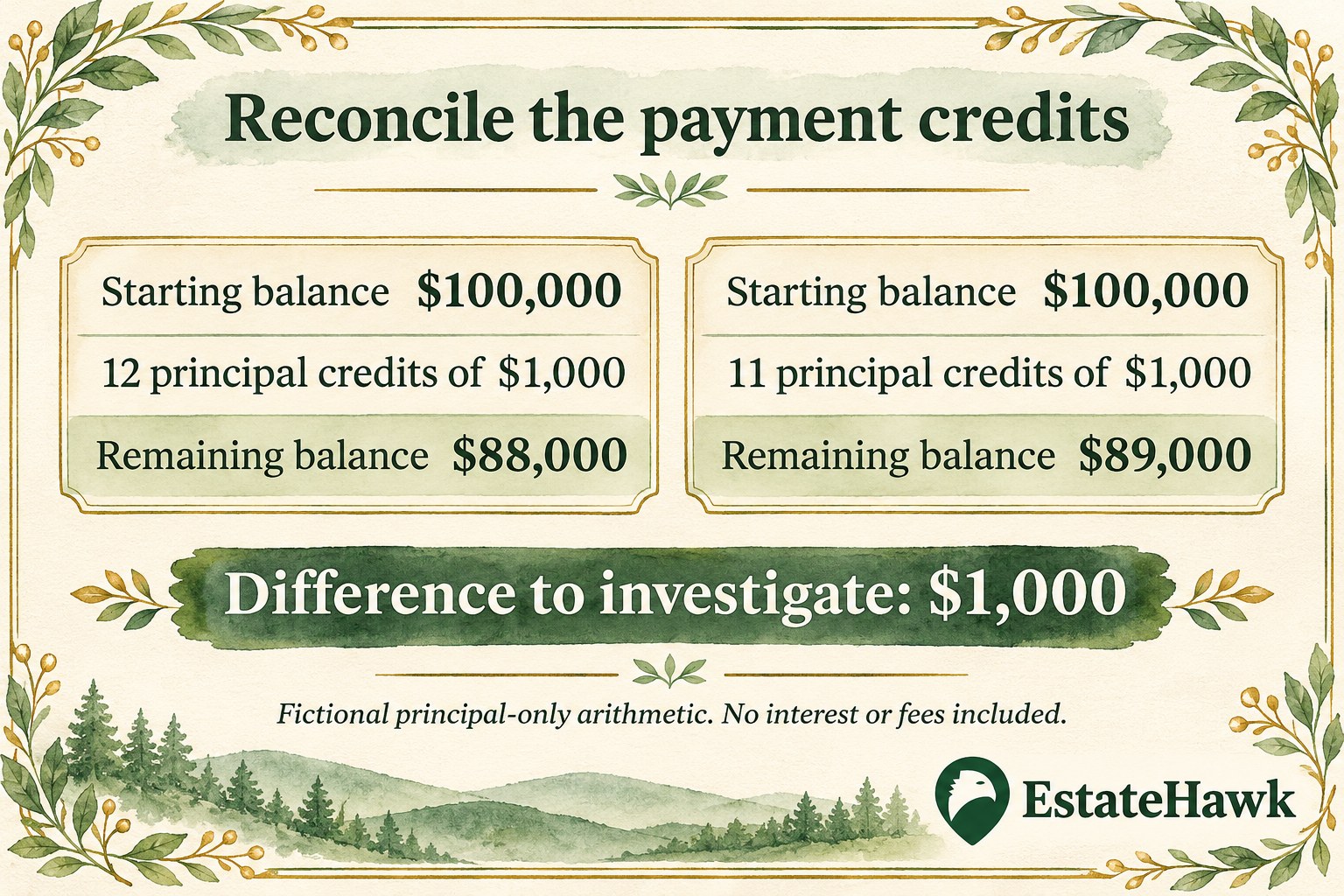
If the seller applies late fees first, less money goes toward principal reduction. That means the principal balance remains higher, which causes more interest to accrue the following month. Over eighty-four months, that subtle accounting discrepancy can alter the final balloon payoff balance by eight, ten, or fifteen thousand dollars.
The buyer thinks they owe sixty-five thousand dollars on their balloon payoff. The seller produces a spreadsheet claiming the payoff is seventy-eight thousand dollars. Neither party has audited ledgers. The buyer cannot obtain a bank refinance loan because the bank's underwriting department requires a verified twelve-month institutional payment history (known as a VOM or Verification of Mortgage), which the private seller cannot legally provide.
Here is the absolute protocol for payment management in any land contract:
First, mandate professional third-party loan servicing in the contract text. There are licensed, bonded private loan servicing companies across the country that service private mortgages and land contracts for a nominal monthly fee of thirty to fifty dollars. The buyer sends payments to the servicing company; the servicing company generates formal monthly statements, calculates interest on exact amortization software, escrows taxes and insurance, issues IRS Form 1098s, and maintains an unassailable digital payment history.
Second, if private servicing is not used, execute a mandatory written payment receipt and annual ledger reconciliation. Never, under any circumstances, pay an installment in cash without a contemporaneous physical receipt signed by the seller stating the exact date, payment method, amount, and allocation to principal, interest, and escrow.
Third, audit the property tax and insurance payments independently. In many land contracts, the buyer pays an estimated monthly amount to the seller to cover property taxes and hazard insurance. But what if the seller pockets the money and does not pay the county treasurer?
County treasurers do not care who paid who. If property taxes go unpaid for two to three years depending on state law, the county initiates a tax lien certificate sale or tax deed foreclosure. The property is sold on the courthouse steps for back taxes, completely extinguishing both the seller's legal title and the buyer's equitable title.
The buyer must verify county tax payments twice a year directly on the county treasurer's public web portal. Do not take the seller's word for it. Pull the official paid receipt from the county tax collector.
The Insurance Trap: HO-3, HO-8, and Loss Payee Endorsements
Insurance in a land contract is a structural trap where both parties routinely commit accidental insurance fraud or leave the property completely unprotected.
When an individual buys a home with a standard bank mortgage, the homeowner purchases a standard HO-3 homeowner's insurance policy, naming the bank as the primary mortgagee and loss payee. The homeowner lives in the home, owns the property, and has an insurable interest in both the structure and personal liability.
In a land contract, who has the insurable interest?
Both parties do. The seller has an insurable interest equal to the unpaid principal balance of the contract. The buyer has an insurable interest equal to their equitable equity and the value of their personal belongings, improvements, and residential occupancy.
Yet, buyers and sellers routinely mishandle this in one of three disastrous ways:
First, the seller leaves their existing standard homeowner's policy in place. This is completely invalid. An HO-3 policy requires the named insured to be an owner-occupant. Once the seller moves out and hands possession to the land contract buyer, the home is no longer owner-occupied by the insured. If the property burns to the ground, the insurance company sends an investigator, discovers the owner does not live there, denies the claim based on material misrepresentation, and voids the policy.
Second, the buyer purchases a standard renter's policy (HO-4). A renter's policy covers only personal property and interior liability. It provides zero coverage for the structural dwelling itself. If a tornado rips the roof off, the renter's policy pays for the buyer's sofa and television, but pays zero dollars to rebuild the framing, electrical systems, or roof.
Third, the buyer purchases a homeowner's policy in their own name alone, without naming the seller. If a fire occurs, the insurance adjuster runs a title check, sees that the deed is registered in the seller's name, and issues a two-party check that cannot be cashed without the seller's signature, or disputes whether the buyer had the legal authority to insure the entire building.
The correct insurance structure requires specialized underwriting:
The property must be covered by a policy designed specifically for contract sales, typically an HO-8 dwelling policy or a specialized dwelling fire policy (DP-1 or DP-3) that explicitly recognizes the land contract arrangement.
Both the buyer and the seller must be named on the declarations page. The buyer is typically listed as the named insured, and the seller is formally endorsed as an "Additional Insured" and "Contract Seller / Loss Payee."
The policy must contain a standard loss payable clause stipulating that in the event of a total casualty loss, insurance proceeds are paid first to the contract seller up to the remaining principal balance of the land contract, with all remaining insurance proceeds paid directly to the contract buyer to rebuild or retain their accrued equity.
The Endgame: Deed Escrow Agreements and Payoff Mechanics
The final payment on a land contract is supposed to be a moment of celebration. In reality, it is often where the entire transaction collapses into acrimonious title litigation.
Imagine this scenario: It is year ten. The buyer has paid ninety-nine thousand dollars over a decade. They make the final five-hundred-dollar payment. They call the seller to demand their deed.
The seller's phone is disconnected.
The buyer drives to the seller's old address; the seller moved to Arizona four years ago and died leaving no will. The seller's heirs are fighting in probate court in Maricopa County. None of the heirs know who the buyer is. Some heirs claim the property is an asset of the estate and demand that the buyer vacate. Other heirs refuse to sign any paperwork without a thirty-thousand-dollar payoff.
Or imagine another common scenario: The seller is alive, but divorced five years into the contract. The ex-spouse was never removed from the deed and now refuses to sign a warranty deed conveying legal title unless they get half the proceeds, even though the contract was signed solely by the former spouse.
Or worse: The seller is willing to sign, but during the eight years of the contract, the seller accumulated three medical debt judgments, a state tax warrant, and a junior mechanic's lien. The seller signs a quitclaim deed, the buyer records it, and then discovers they have inherited twenty-eight thousand dollars in clouds on title that must be paid off before the buyer can ever sell or refinance the home.
All of these nightmares are prevented by implementing a formal Deed in Escrow at the very beginning of the contract.
When the land contract is executed, the seller must simultaneously execute a formal, fully acknowledged General Warranty Deed conveying the property to the buyer.
That executed deed is not handed to the buyer immediately, nor is it kept in the seller's desk. It is delivered to an independent, bonded third-party escrow agent, such as a licensed title insurance company or an attorney escrow trust account, accompanied by a written, irrevocable Escrow Agreement.
The Escrow Agreement explicitly dictates that the escrow agent holds the deed in trust. Once the buyer presents verified proof of final payoff, whether through third-party servicing statements or a written payoff verification signed by both parties, the escrow agent has the absolute legal authority to release and record the warranty deed directly into the county land records.
If the seller dies, moves, gets divorced, or becomes legally incapacitated during the contract term, the escrow agent's authority to deliver the executed deed remains legally binding under escrow law. The delivery relates back to the original date of deposit into escrow, bypassing the seller's probate estate entirely.
Comprehensive Land Contract Verification Ledger
Before committing capital, signing contracts, or taking physical occupancy, use this structured verification protocol to audit every legal and financial coordinate of the proposed installment transaction:
Ledger columns: Review Coordinate; Verification Target; Primary Failure Mode; Regulatory & Record Source
Seller Record Authority
- Verification Target: Verify that the selling entity matches the exact grantee name on the last recorded deed.
- Primary Failure Mode: The seller is a single heir of an unprobated estate or a managing partner lacking organizational authority.
- Regulatory & Record Source: County Deed Registry, Certified Letters of Administration, LLC Operating Agreement.
Underlying Mortgages
- Verification Target: Verify whether any senior deeds of trust or mortgages encumber the legal title.
- Primary Failure Mode: Seller defaults on hidden bank debt, triggering due-on-sale acceleration or senior foreclosure.
- Regulatory & Record Source: County Mortgage Index, Garn-St. Germain (12 U.S.C. § 1701j-3), Written Bank Disclosures.
Contract Recording
- Verification Target: Verify whether state law mandates recording and prepare a recordable memorandum.
- Primary Failure Mode: Pocket contract remains unrecorded, allowing junior liens or second buyers to wipe out equity.
- Regulatory & Record Source: Ohio ORC § 5313.02(C), Texas Prop Code § 5.076, County Recorder Document Standards.
Statutory Default Thresholds
- Verification Target: Identify whether state law requires judicial foreclosure versus summary forfeiture upon default.
- Primary Failure Mode: Buyer assumes they have mortgage rights, but faces 15-day summary eviction under harsh forfeiture laws.
- Regulatory & Record Source: Ohio ORC § 5313.07, Michigan MCL § 600.5744, Texas Prop Code § 5.066, Florida F.S. § 697.01.
Property Tax Uncapping
- Verification Target: Verify whether entering the installment contract resets the property's taxable assessed value.
- Primary Failure Mode: Buyer budgets based on old tax bills, then gets hit with a 200% tax increase post-execution.
- Regulatory & Record Source: Michigan Form 2766, County Assessor Transfer Rules, State Property Tax Guidelines.
Deed Escrow Deposit
- Verification Target: Confirm whether an executed general warranty deed is deposited with an independent third party.
- Primary Failure Mode: Seller dies or disappears before final payoff; buyer forced into costly quiet title litigation.
- Regulatory & Record Source: Formal Third-Party Escrow Agreement, State Escrow Law, Title Company Trust Deposit.
Payment Ledger Architecture
- Verification Target: Establish third-party loan servicing with automated amortization and tax escrow management.
- Primary Failure Mode: Mismatched cash receipts, uncredited payments, and disputed balloon payoff balances.
- Regulatory & Record Source: CFPB Reg Z Servicing Standards, RESPA Escrow Guidelines, Licensed Servicing Records.
Insurance Endorsements
- Verification Target: Secure an HO-8 or dwelling fire policy naming both parties as insured and loss payee.
- Primary Failure Mode: Seller keeps invalid owner-occupant HO-3; total casualty claim denied for misrepresentation.
- Regulatory & Record Source: State Insurance Commissioner Regulations, Standard Loss Payable Endorsement Provisions.
Case Study: The Cuyahoga County Unrecorded Contract and the Five-Year Statutory Line
To understand how these legal mechanics operate in real courtrooms, consider the real estate dispute that unfolded in Cuyahoga County, Ohio, involving a residential duplex on West 65th Street in Cleveland.
In May 2018, an investor named Marcus executed a land installment contract to sell the property to a local mechanic named Darrell for ninety thousand dollars. Darrell paid ten thousand dollars down in certified funds and agreed to pay eight hundred and fifty dollars a month at an interest rate of six percent, with a balloon payoff required at the end of sixty months (May 2023).
Marcus did not record the land contract in the Cuyahoga County Fiscal Officer's land records. He told Darrell that recording fees were a waste of city money and that they would record everything together when Darrell paid off the balloon. Marcus also kept his existing residential homeowner's policy active on the building.
Over the next four years and eleven months, Darrell lived in the lower unit, rented out the upper unit, and paid his eight hundred and fifty dollars every single month. In total, between the down payment and monthly principal reductions, Darrell paid over twenty-two thousand dollars toward the principal purchase price, well in excess of twenty percent of the ninety-thousand-dollar contract price.
In April 2023, just one month before the sixty-month mark, Marcus faced a massive personal tax judgment from the State of Ohio for an unrelated business failure, resulting in a thirty-five-thousand-dollar judgment lien recorded against all real property in Marcus's name in Cuyahoga County.
Simultaneously, Darrell approached a local credit union to refinance the property and pay off the remaining sixty-eight-thousand-dollar balloon balance.
The credit union's title examiner pulled the title search and halted the loan immediately:
First, Marcus was the sole owner of record, and the thirty-five-thousand-dollar state tax lien had attached directly to the property's legal title because Darrell's land contract was completely absent from the county records.
Second, the credit union could not verify Darrell's payment history because Darrell had paid Marcus through informal mobile transfers and occasional cash pickups, with zero official monthly mortgage statements.
When Darrell refused to pay the inflated balloon demand that Marcus generated to cover his personal tax issues, Marcus served Darrell with an immediate notice of forfeiture and filed an eviction action in Cleveland Municipal Court, claiming Darrell was a holdover tenant whose contract had expired without payoff.
Darrell retained local legal counsel who immediately removed the dispute from the municipal eviction docket to the Cuyahoga County Court of Common Pleas:
Counsel invoked Ohio Revised Code Section 5313.07. Because Darrell had paid more than twenty percent of the purchase price, the statute explicitly stripped the municipal court of jurisdiction to proceed with summary eviction or forfeiture. Ohio law required a formal judicial foreclosure.
Counsel also filed an action for specific performance, equitable accounting, and quiet title, recording a formal Lis Pendens in the county land records. Under Ohio law, the court reconstructed the true amortization schedule, crediting every verified bank transfer against principal and interest.
Because Darrell's attorney proved Marcus had violated ORC 5313.02 by failing to record the contract within twenty days of signing, the court sanctioned Marcus, prevented him from claiming late fees or disputed balance penalties, and ordered that the state tax lien could only attach to Marcus's remaining net equity after Darrell's equitable title was satisfied.
Darrell ultimately acquired clear legal title through a court-supervised payoff, but the legal battle cost eighteen months of litigation and more than twelve thousand dollars in legal fees. Had the land contract been recorded in May 2018 alongside a formal Deed in Escrow, Marcus's personal tax lien could never have clouded Darrell's equity, and the dispute would have been resolved in a thirty-minute closing.
Case Study: The Wayne County Property Tax Uncapping and Forfeiture Battle
A second instructive case study occurred in Wayne County, Michigan, involving a single-family home on Outer Drive in Detroit.
In November 2021, an out-of-state investment firm sold a rehabilitated brick colonial to a buyer named Elena on a land contract for one hundred and twenty thousand dollars with twelve thousand dollars down. The contract stated that Elena would pay one thousand one hundred dollars a month, which included an estimated two hundred dollars per month to cover property taxes.
The investment firm recorded the land contract at the Wayne County Register of Deeds, but neither party filed Michigan Treasury Form 2766 (Property Transfer Affidavit) with the local assessor's office.
Because the previous owner had lived in the home for twenty-two years, the property's taxable value was capped at nineteen thousand dollars under Michigan's Proposal A, resulting in an annual property tax bill of approximately eighteen hundred dollars.
Fourteen months into the contract, the local tax assessor conducted a routine audit of recorded instruments and discovered the recorded land contract. Under Michigan Compiled Laws Section 211.27a, the execution of the land contract was a transfer of ownership, which instantly uncapped the property's taxable value.
The assessor reassessed the property based on the current market value of one hundred and twenty thousand dollars, doubling the taxable value to sixty thousand dollars. The annual property tax bill skyrocketed from eighteen hundred dollars to five thousand six hundred dollars.
Furthermore, because Form 2766 had not been filed within forty-five days, the county assessed retroactive penalties and back taxes for the preceding tax year.
The investment firm received the massive new tax bill, paid the back taxes out of company funds, and immediately delivered an emergency notice to Elena demanding that she reimburse the firm four thousand two hundred dollars within thirty days and increase her monthly escrow payment from two hundred dollars to five hundred dollars a month.
Elena, who worked as an administrative assistant, could not produce four thousand dollars in thirty days. When the thirty days passed, the investment firm served her with a formal fifteen-day Notice of Forfeiture under Michigan Compiled Laws Section 600.5728 and filed a summary proceeding in 36th District Court to evict her.
Elena contacted a local legal aid organization, which raised critical statutory defenses:
Counsel proved that the investment firm, as an experienced corporate vendor, had drafted the contract and explicitly represented the monthly escrow figure as sufficient to cover taxes, while failing in its statutory duty to advise the buyer of the mandatory Form 2766 filing.
When the district judge entered a judgment of possession, Elena's counsel asserted her absolute statutory rights under MCL Section 600.5744. Because Elena had made timely monthly payments and paid her down payment, the court established the exact statutory redemption amount and granted Elena a ninety-day stay of eviction.
Working with a local community development financial institution (CDFI), Elena obtained an emergency residential refinance loan that paid off the investment firm in full during the ninety-day redemption window.
The investment firm was forced to deliver a covenant deed, and Elena preserved her home. Had she not known her statutory redemption rights under Michigan law, she would have packed her bags within two weeks of receiving the forfeiture notice, forfeiting twelve thousand dollars in down payment equity and over twenty thousand dollars in home improvements.
Practical Realities and Structural Protocols
When evaluating a proposed land contract, you must examine the documentation not through the lens of optimistic promises, but through the rigorous lens of enforceability, statutory compliance, and title security.
First, demand a preliminary title commitment from an independent title insurance agency before executing any documents or handing over down payment funds. Never rely on the seller's assurance that title is free and clear. A title commitment reveals all existing mortgages, delinquent real estate taxes, municipal water liens, building code violations, and judgment liens recorded against the property and the seller. If the seller refuses to permit a title search, terminate discussions immediately.
Second, ensure the legal instrument contains explicit provisions governing casualty insurance, condemnation proceeds, repair obligations, and property inspection rights. The contract must specifically designate who is responsible for structural repairs versus ordinary maintenance, and must establish clear guidelines for obtaining municipal permits when capital improvements are undertaken.
Third, establish an ironclad mechanism for deed delivery. The contract must state whether the seller is obligated to deliver a General Warranty Deed, a Special Warranty Deed, or a Covenant Deed upon completion. Under no circumstances should a buyer accept a Quitclaim Deed as the designated conveyance instrument in a long-term installment sale, as a quitclaim deed provides zero legal covenants of title and will render obtaining title insurance difficult or impossible at payoff.
Fourth, verify whether local municipal ordinances impose point-of-sale inspections or rental registration requirements on land contracts. In several industrial Midwest municipalities, local codes classify unrecorded or even recorded land contracts as rental properties until legal title transfers, requiring the seller to pass intensive building code inspections and obtain lead-safe certifications before occupancy can be legally granted.
A land contract is not a casual handshake agreement. It is an intricate, multi-year conveyance that requires the exact same legal diligence, recording precision, and accounting oversight as an institutional real estate closing. By locking down recording, auditing underlying debt, enforcing statutory cure rights, and depositing deeds in independent escrow, buyers and researchers protect their equity from the chaos of informal finance.