
DSCR Loan: Income Calculations and Requirements to Verify
A rental-income ratio is one lending input. Check the program definition, document the rent and payment basis, and build a separate ownership budget.
 By EstateHawk
On this page

Let's talk about the act of borrowing hundreds of thousands of dollars without showing a tax return. If you listen to real estate influencers on YouTube, your first tip for scaling a massive rental portfolio is almost always to get a DSCR loan and let the property qualify itself.
Who would have thought?
Don't show your W-2, don't show your personal tax returns, don't calculate your personal debt-to-income ratio, and simply hand the lender a lease agreement showing that the tenant pays more than the mortgage. Truly dazzling financial innovation. So elegant in its simplicity. So breathtakingly catastrophic when you discover three days before closing that the lender underwrites debt service using full PITIA including taxes, insurance, and HOA dues, cuts your appraised market rent using Fannie Mae Form 1007, drops your Debt Service Coverage Ratio below one point zero, and demands an extra forty-five thousand dollars in cash down payment plus nine months of liquid post-closing reserves.
While we're distributing revolutionary advice, let's make sure deep-sea saturation divers remember to take off their breathing regulators whenever they get hiccups. Let's make sure skydivers remember to unclip their parachutes to enjoy a better breeze during freefall.
No, "just get a DSCR loan with no income documentation" is advice manufactured for fake rental moguls. It belongs to the guru crowd who believe that Non-QM private lending is an unregulated candy store where lenders hand out half-million-dollar checks to anyone with a pulse and a Zillow screenshot. Those people think "no personal income verification" means the lender does zero underwriting and ignores risk.
Here's what the mortgage broker sales pitches and superficial investor videos will never explain: for an authentic Non-QM mortgage underwriter, private credit analyst, or commercial loan officer, evaluating a DSCR loan isn't a casual ratio check, it's an obsession they have zero control over.
If you let an authentic credit underwriter anywhere near a DSCR loan file, their brain completely disconnects from all standard conversational pleasantries. Normal investors look at the property and celebrate skipping a personal tax audit. The document obsessive could not care less about skipping tax returns. They want to know whether the gross qualifying rent was benchmarked against an independent Fannie Mae Form 1007 Single-Family Comparable Rent Schedule, whether the debt service denominator includes true post-sale county property tax reassessments and flood insurance riders, whether the promissory note contains a stepped-down five-year prepayment penalty under Consumer Financial Protection Bureau guidelines, and whether the borrower's liquid post-closing reserves can cover nine continuous months of PITIA payments sitting in verified depository accounts.
In fact, if you leave that researcher unsupervised at two in the morning with an open browser, they won't even be reviewing DSCR lending matrices at all. They will have fallen headfirst into an algorithmic rabbit hole on a Polish military vehicle restoration forum, studying auction listings for a decommissioned Soviet MT-LB heavy amphibious multi-purpose tracked armored carrier. They will spend two solid hours examining technical schematics of its 240-horsepower YaMZ-238 V-8 diesel engine and low-ground-pressure stamped steel tracks, analyzing how its watertight hull allowed it to transport eleven armed infantrymen through freezing swamp bogs at thirty-eight miles an hour, calculating whether its amphibious tracks would throw a drive pin while climbing a thirty-degree muddy riverbank in the Carpathian Mountains, and reading translated forum flame wars from 2011 about whether synthetic cold-weather steering clutch fluid causes seal degradation in Arctic sub-zero conditions.
Then the Instant Gratification Monkey at the back of their skull suddenly gets hit with a cold wave of pure dread. The Rational Decision-Maker kicks down the door, drags them away from Soviet amphibious tracked armored carriers, and slams their face back into the lender's loan commitment. Because right there in the underwriting conditions is a required 1.25 DSCR ratio, and the appraiser's market rent estimate just came back two hundred dollars lower than the seller's active lease.
Welcome to the strict, highly structured, and unforgiving world of the DSCR Loan.
The foundational trap that destroys real estate investors in the Non-QM lending space begins with a complete failure to understand what a DSCR loan actually is.
A DSCR loan, short for Debt Service Coverage Ratio loan, is a specialized, business-purpose mortgage product designed exclusively for residential investment properties, typically one to four units.
The defining characteristic of a DSCR loan is its underwriting methodology:
Instead of evaluating the borrower's personal income, employment history, W-2 statements, tax returns, and personal debt-to-income (DTI) ratios under standard Qualified Mortgage rules, the lender evaluates the cash-flow generating capacity of the real estate itself.
If the property generates sufficient verified rental income to cover its monthly mortgage debt obligations by an acceptable coverage margin, the loan qualifies.
However, notice the phrase: business-purpose investment property.
A DSCR loan cannot, under any circumstances, be used to purchase a primary residence, a second home, or any property intended for personal or family occupancy.
If a borrower applies for a business-purpose DSCR loan and secretly moves their family into the property, that borrower has committed federal mortgage fraud. Lenders require borrowers to sign explicit occupancy affidavits certifying under penalty of perjury that the property is acquired strictly as an investment rental.
Now let us examine the core mathematical formula: how is a residential DSCR actually calculated?
In commercial real estate, DSCR divides Net Operating Income by annual debt service.
However, in residential 1-to-4 unit DSCR lending, lenders almost universally use a specific monthly formula:
Qualifying Gross Monthly Rental Income divided by Monthly Housing Debt Service (PITIA).
Look at the components of the denominator: PITIA.
P: Principal.
I: Interest.
T: Property Taxes.
I: Hazard, Flood, and Windstorm Insurance.
A: Association Dues (Homeowners Association or Condominium fees).
Look at how amateur investors completely bungle this calculation:
An investor finds a single-family home that rents for $2,500 per month.
The investor opens an online mortgage calculator, types in a $200,000 loan at seven percent interest, and sees a principal and interest payment of $1,330 per month.
The amateur investor does simple division: $2,500 rent divided by $1,330 mortgage payment equals a DSCR of 1.88.
The investor tells themselves: "My DSCR is 1.88! I have a massive safety cushion!"
Then the file arrives on the desk of an institutional DSCR underwriter.
The underwriter audits the true monthly housing obligation:
Monthly Principal and Interest: $1,330.
Monthly County Property Taxes: $420.
Monthly Hazard and Liability Insurance: $160.
Monthly Homeowners Association Dues: $90.
The true monthly PITIA debt service is not $1,330.
The true monthly PITIA is $2,000.
Now run the real underwriting calculation:
Take the $2,500 qualifying monthly rent. Divide it by the true $2,000 PITIA debt service.
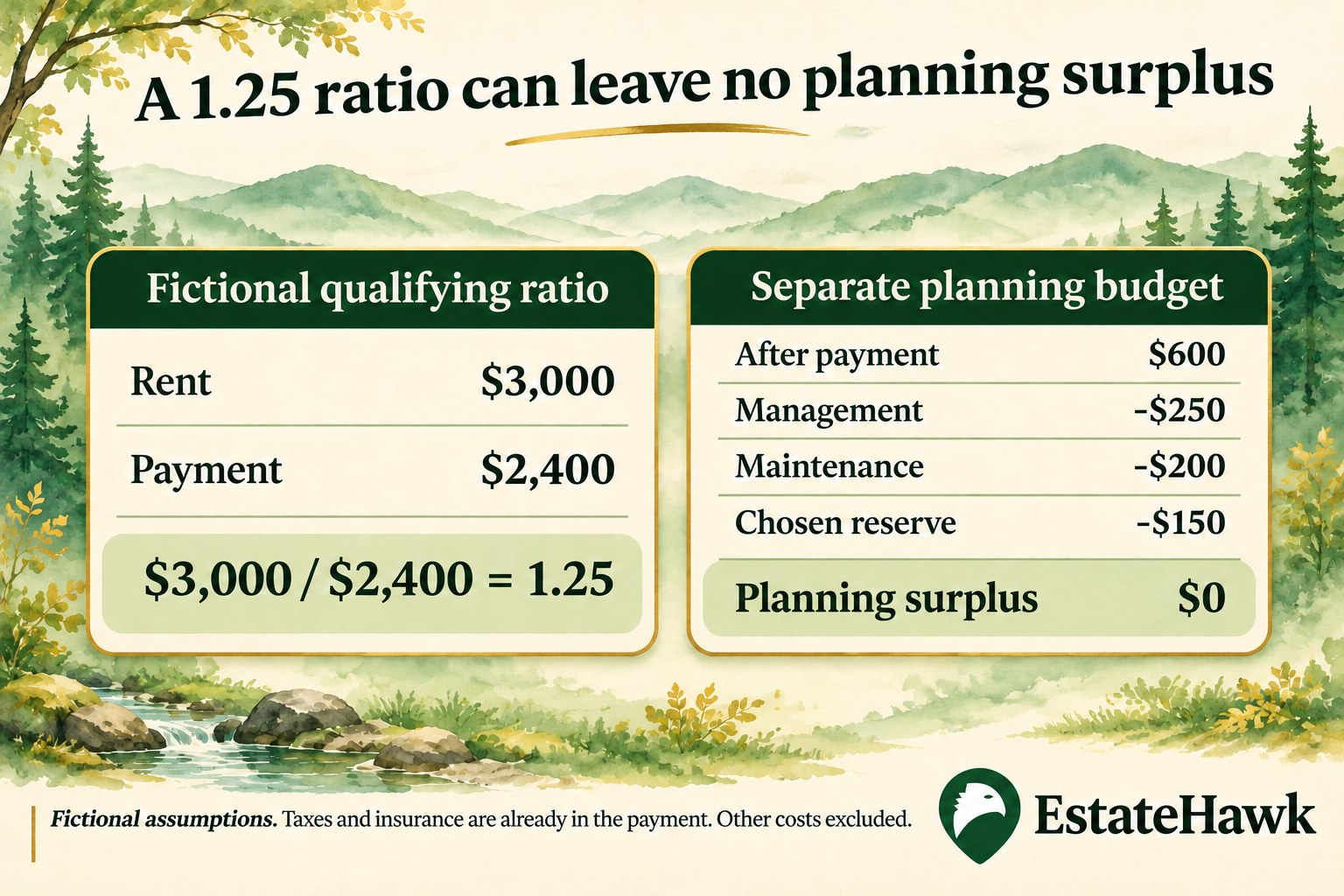
The true DSCR is 1.25.
Notice what happened. The ratio collapsed from an imaginary 1.88 straight down to 1.25.
Why does 1.25 matter?
Because 1.20 to 1.25 is the standard benchmark minimum coverage ratio required by major Non-QM institutional secondary market investors, such as Plaza Home Mortgage guidelines and private credit aggregators.
A DSCR of 1.25 means that for every single dollar of required monthly housing debt, the property generates one dollar and twenty-five cents in gross rent.
That extra twenty-five cents represents the lender's safety buffer to absorb vacancy downtime, routine repairs, and maintenance.
Now look at what happens when a ratio drops below 1.0.
A DSCR below 1.0 means the property does not produce enough rent to cover its basic monthly PITIA payments. A property with $1,800 in rent and $2,000 in PITIA has a DSCR of 0.90. The property has negative cash flow.
While some specialized private lenders offer "No-Ratio" or "Sub-1.0 DSCR" loan programs, those programs come with punitive underwriting terms: lenders slash the maximum Loan-to-Value ratio from eighty percent down to sixty-five or seventy percent, demand significantly higher interest rates, and require massive liquid cash reserves.
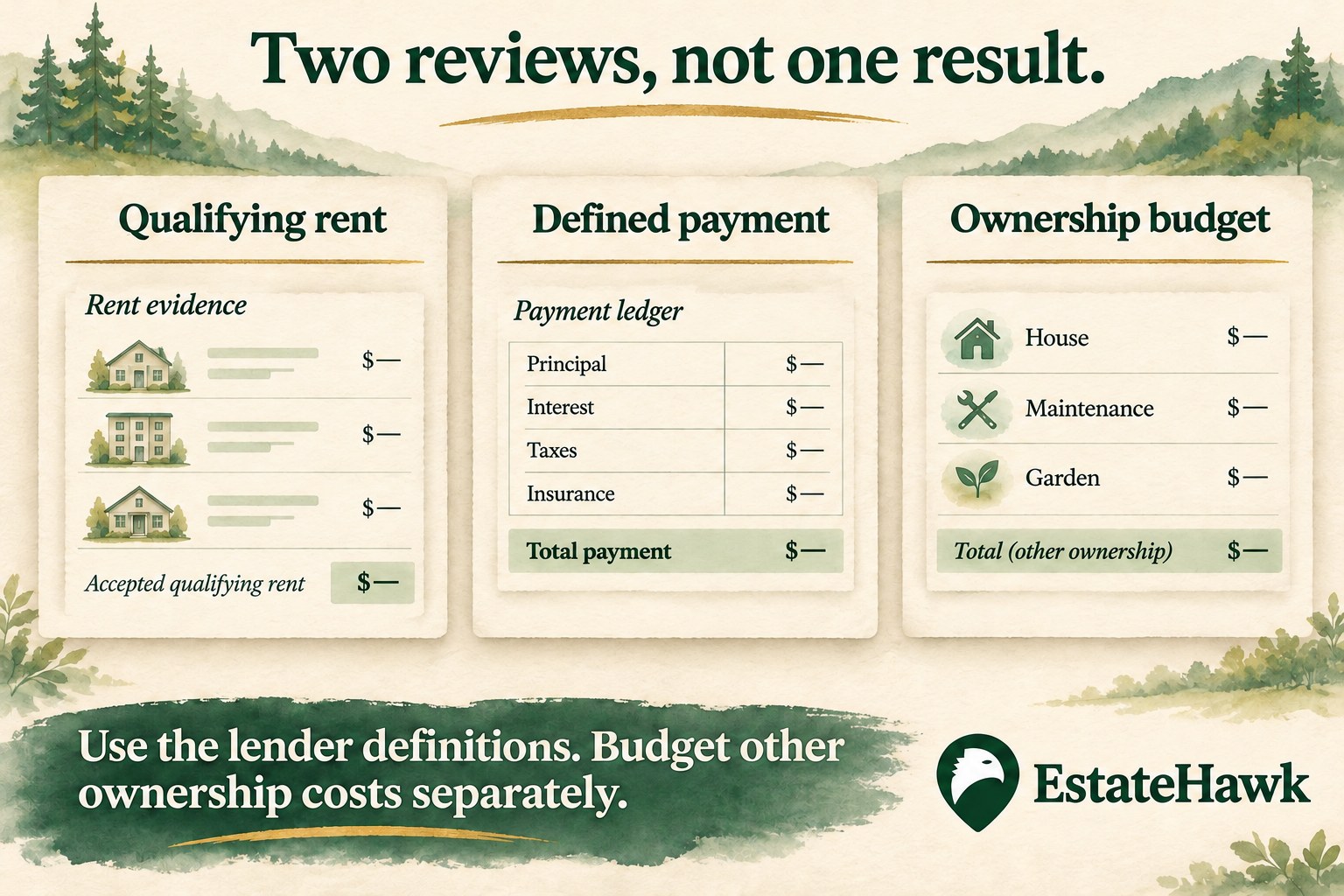
Now let us examine the single most common failure point in DSCR underwriting: the rent verification trap and Fannie Mae Form 1007.
Amateur investors believe that whatever rent is written on the tenant's lease is the rent the lender will use.
That is an absolute illusion.
When you apply for a DSCR loan, the lender orders an independent, certified appraisal through an appraisal management company.
Alongside the standard appraisal report, the lender mandates that the appraiser complete a specific Fannie Mae form: Form 1007, the Single-Family Comparable Rent Schedule.
The appraiser researches closed rental comps in the immediate micro-neighborhood and determines the certified Fair Market Rent for the subject property.
Now look at how the underwriter reconciles the numbers:
If the property is occupied by an existing tenant, the underwriter compares the in-place lease agreement with the appraiser's Form 1007 market rent.
Under standard Non-QM underwriting rules, the lender will use the LOWER of the actual in-place lease rent or the appraiser's Form 1007 market rent.
If your tenant signed a lease for $2,800 a month, but the independent appraiser determines that fair market rent in that subdivision is only $2,400 a month, the underwriter will throw your $2,800 lease into the trash can and underwrite the loan using $2,400.
If your property is vacant at the time of purchase, the lender underwrites the DSCR strictly to the appraiser's Form 1007 market rent.
Furthermore, look at Short-Term Rentals, such as Airbnb or VRBO properties.
Amateur investors love buying vacation rentals, downloading an optimistic revenue projection from AirDNA showing eighty thousand dollars in projected annual revenue, and expecting the DSCR lender to qualify the loan based on that number.
In the real lending world, most institutional DSCR lenders fiercely reject third-party algorithmic projections.
Lenders demand an unbroken twelve-month historical operating statement (a T-12 ledger) showing verified past revenue. If historical records are unavailable because the home is newly converted to a vacation rental, most DSCR underwriters will ignore the vacation rental business entirely and qualify the loan based solely on standard long-term residential market rent from Form 1007.
Now let us dismantle the famous myth that DSCR loans require zero financial scrutiny of the borrower.
Amateur investors love repeating: "DSCR loans look only at the property, not the borrower!"
That is complete nonsense.
While DSCR lenders do not audit personal W-2s or tax returns, they subject the borrower's personal credit profile and liquidity to fierce forensic verification:
First, look at credit scores.
DSCR lenders are obsessed with credit scores. A traditional Fannie Mae conventional loan might accept a 620 FICO score. A DSCR lender typically demands a minimum 660 to 680 credit score, with the best interest rates and eighty percent LTV limits reserved strictly for borrowers with FICO scores of 720 or higher. A twenty-point drop in credit score can increase your interest rate by a full percentage point or cut your permitted loan amount by ten percent.
Second, look at post-closing liquid reserves.
This is where novice borrowers get completely wiped out at the closing table.
A DSCR lender will never allow a borrower to drain their bank account to zero to fund the down payment.
Lenders mandate that the borrower must possess verified liquid post-closing reserves sitting in an insured depository bank account after all down payment and closing costs have been wired.
Standard DSCR underwriting matrices mandate between six and twelve months of full PITIA payments held in liquid reserves.
If your monthly PITIA is $2,000, and the lender mandates nine months of reserves, you must prove that you have $18,000 in liquid cash, money market funds, or vested brokerage securities untouched in your bank account on closing morning.
Now look at the hidden transactional traps: Prepayment Penalties and Interest-Only terms.
Because DSCR loans are exempt from federal consumer Truth in Lending Act restrictions that protect primary homeowners, lenders routinely include aggressive commercial clauses:
The most dangerous is the Prepayment Penalty.
Nearly every competitive DSCR loan contains an explicit prepayment penalty, typically structured as a 3-2-1 or 5-4-3-2-1 step-down penalty.
Under a 5-4-3-2-1 structure, if you sell the property or refinance the mortgage in year one, you must pay a cash penalty of five percent of the entire loan balance to the lender.
On a three-hundred-thousand-dollar loan, a five percent prepayment penalty is fifteen thousand dollars in cold cash.
If you plan to renovate the property, force appreciation, and refinance or sell within twelve to twenty-four months, an unaddressed prepayment penalty will completely devour your equity spread. You must negotiate a zero-prepayment penalty or a shorter one-year penalty upfront in exchange for a slightly higher interest rate.
Second, look at Interest-Only features.
Many DSCR lenders offer five-year or ten-year Interest-Only (I/O) payment options.
An interest-only payment lowers your monthly debt service during the initial years, significantly boosting your calculated DSCR and increasing monthly cash flow.
However, an interest-only loan does not pay down a single dollar of principal.
When the interest-only period expires at month sixty or one hundred and twenty, the loan recasts into a fully amortizing payment over the remaining term, causing a massive monthly payment shock that can turn a profitable rental into a cash-flow drain.
Let us walk through an educational case study that demonstrates how an unverified DSCR calculation nearly destroyed an acquisition.
Consider an investor named Trevor who enters into a purchase agreement to buy an attractive single-family rental home on Glenwood Drive for $340,000.
Trevor plans to use a DSCR loan at eighty percent Loan-to-Value, borrowing $272,000, requiring a twenty percent cash down payment of $68,000.
The property is currently leased to a tenant for $2,700 per month.
Trevor opens an online mortgage calculator. He calculates a principal and interest payment of $1,800 per month on the $272,000 loan balance.
Trevor tells himself: "Rent is $2,700. My payment is $1,800. My DSCR is 1.50! The loan will sail through underwriting!"
Trevor deposits $10,000 in earnest money with the title company, waives his financing contingency after a preliminary conversation with a mortgage broker, and sets closing for thirty days out.
Two weeks before closing, the lender's formal underwriting commitment arrives.
Trevor receives a devastating shock.
First, the lender's underwriter audits the true monthly debt service:
Monthly Principal and Interest: $1,800.
Monthly County Real Estate Taxes: $480.
Monthly Hazard and Flood Insurance: $240.
Monthly HOA Dues: $180.
True Monthly PITIA Debt Service: $2,700.
Second, the appraiser completes Fannie Mae Form 1007.
The appraiser determines that the current tenant is paying above-market rent, and establishes the certified Fair Market Rent for the neighborhood at $2,400 per month.
The underwriter throws out Trevor's $2,700 lease and underwrites the loan using the $2,400 appraisal market rent.
Look at the true underwritten DSCR:
Take the $2,400 qualifying market rent. Divide it by the true $2,700 PITIA debt service.
The underwritten DSCR is 0.88.
The property has negative cash flow.
The lender's underwriting department refuses to approve the eighty percent LTV loan.
The lender issues a conditional counter-offer: to approve the loan with a 0.88 DSCR, the lender slashes the maximum Loan-to-Value ratio from eighty percent down to sixty-five percent.
Instead of lending $272,000, the lender will only lend $221,000.
Look at the financial catastrophe Trevor now faces:
To complete the purchase, Trevor's required down payment jumps overnight from $68,000 to $119,000. Trevor must bring an extra $51,000 in cash to the closing table.
Furthermore, because the DSCR is below 1.0, the lender mandates nine months of post-closing liquid reserves, requiring Trevor to prove an additional $24,300 in verified bank savings.
Trevor does not have an extra seventy-five thousand dollars in liquid cash.
Because Trevor foolishly waived his financing contingency, Trevor cannot cancel the contract without breaching the agreement.
The seller refuses to extend the closing date. The contract collapses. The seller retains Trevor's entire $10,000 earnest money deposit as liquidated damages.
Trevor lost ten thousand dollars in cash capital because he calculated his DSCR using only principal and interest and assumed the lender would accept an above-market lease agreement.
Now let us examine the four conversational questions that constantly arise whenever property investors evaluate DSCR loans.
The first question involves property occupancy: Can a borrower use a DSCR loan to purchase a single-family home to live in personally as a primary residence?
No. That is an absolute prohibition under federal lending law. DSCR loans are Non-QM business-purpose loans intended exclusively for income-generating rental properties. Borrowers must execute legal occupancy affidavits certifying under penalty of perjury that the property is acquired strictly as an investment and that neither the borrower nor any family member will occupy the dwelling. Moving into a property financed with a business-purpose DSCR loan constitutes criminal mortgage fraud under federal statutes.
The second question concerns appraisal discrepancies: What happens if the certified market rent on Fannie Mae Form 1007 is lower than the actual signed tenant lease?
Under standard institutional DSCR underwriting guidelines, lenders almost universally adhere to the lower-of rule. If the physical tenant lease shows rent of $2,500, but the independent appraiser's Form 1007 rent schedule establishes fair market rent at $2,200, the underwriter will qualify the loan based strictly on the lower $2,200 appraisal figure. This lower qualifying income reduces your calculated DSCR, which can force the lender to cut your permitted loan amount, increase your required down payment, or deny the loan entirely.
The third question involves loan exit terms: Do DSCR loans carry prepayment penalties when the investor decides to sell or refinance?
Yes. Unlike conventional consumer mortgages governed by Fannie Mae rules where prepayment penalties are strictly prohibited, most commercial and Non-QM DSCR loans contain explicit prepayment penalties. These are typically structured as step-down penalties, such as 3-2-1 or 5-4-3-2-1, requiring the borrower to pay a substantial cash penalty, often several thousand to tens of thousands of dollars, if the loan is paid off, refinanced, or the property is sold within the penalty window. Borrowers must negotiate prepayment terms upfront during the initial rate-lock discussion.
The fourth question addresses software: Where do modern property intelligence platforms and automated underwriting tools fit into DSCR loan analysis?
Online real estate software platforms and property intelligence databases are invaluable preliminary tools for reviewing neighborhood rental trends, pulling historical tax assessments, checking parcel boundaries, and screening prospective deals. However, automated software algorithms cannot issue a certified Fannie Mae Form 1007 appraisal, review physical lease documents, or underwrite a Non-QM credit package. Digital research must always be paired with an experienced commercial mortgage broker, licensed appraisal management companies, and professional escrow officers before executing binding real estate purchase contracts.
When you pursue a DSCR loan for a rental acquisition, approach the financing with absolute mathematical discipline.
Never calculate debt service using only principal and interest. Include full taxes, insurance, and association dues to establish your true PITIA denominator. Benchmark your gross rent against conservative neighborhood market comps, verify your liquid post-closing reserves, and audit your prepayment penalty terms before locking your rate.
Operating with that level of financial and procedural rigor is what protects your capital, preserves your equity, and ensures that your property portfolio is built on sustainable, bankable real estate debt rather than optimistic spreadsheet illusions.