
Vacant Home Insurance: Questions Before You Leave
An empty home can change the coverage conversation. Prepare the facts, compare the wording and document what the insurer confirms.
 By EstateHawk
On this page

Let's talk about the act of leaving a house empty. If you listen to casual homeowner chatter, your first piece of advice when moving out of a property you're trying to sell is almost always to keep paying your standard homeowner insurance premium and leave a lamp on a timer.
Who would have thought?
Keep mailing your regular ninety-dollar monthly insurance check, plug an electric floor lamp into a five-dollar mechanical wall timer in the living room, and rest easy knowing that your standard policy will happily cover you if a disaster strikes. Truly breathtaking financial optimism. So elegant in its simplicity. So exquisitely horrifying when a copper pipe bursts during a January freeze, pours eighty thousand gallons of freezing water through the ceiling, and the insurance claims adjuster denies your seventy-five-thousand-dollar claim with a cold, formal letter citing the standard sixty-day vacancy exclusion clause buried on page twenty-seven of your policy.
While we're handing out miracle advice, let's make sure commercial airline pilots remember to avoid turning off the jet engines at thirty thousand feet to conserve aviation fuel. Let's make sure deep-sea scuba divers remember to avoid filling their dry suits with hydrochloric acid.
No, "just keep paying the regular policy" is advice manufactured for fake property owners. It belongs to the retail crowd who believe that an insurance policy is a universal, unconditional golden blanket that protects any building you happen to own, regardless of what you actually do with it. Those people think an insurance underwriter views an empty, dark, unmonitored suburban house with the exact same risk profile as a home with two adults, three children, and a golden retriever living inside every single day.
Here's what the insurance advertisements and superficial advice columns will never explain: for an authentic risk underwriter or property asset manager, verifying vacant property coverage isn't a casual administrative check, it's an obsession they have zero control over.
If you let an authentic insurance obsessive anywhere near an empty property, their brain completely disconnects from all standard conversational pleasantries. Normal people look at the vacant house and notice that the carpet has been professionally steam-cleaned. The document obsessive could not care less about the carpet. They want to know whether the policy defines the property as vacant or merely unoccupied, whether the vacancy countdown begins on the exact date of physical departure or the date of policy renewal, whether the water utility main has been shut off and drained at the lowest fixture, whether the policy mandates weekly documented interior physical walk-throughs, and whether the heating thermostat is set to maintain a minimum continuous indoor temperature of fifty-five degrees Fahrenheit under strict policy warranty conditions.
In fact, if you leave that researcher unsupervised at two in the morning with an open browser, they won't even be reviewing insurance policy endorsements at all. They will have fallen headfirst into an internet rabbit hole on a German heavy vehicle restoration forum, studying auction listings for a decommissioned East German NVA PTS-M amphibious tracked transporter. They will spend two solid hours examining technical schematics of its 350-horsepower V-12 diesel engine and massive twin rear water propellers, analyzing how its watertight steel boat hull allowed it to transport a ten-ton military cargo truck across the flooded Elbe River at eight miles an hour, calculating whether its wide steel track pads would chew through a frozen suburban driveway without tearing up the concrete curb, and reading translated forum debates from 2008 about whether replacement propeller shaft stuffing boxes leak when submerged in brackish water.
Then the Instant Gratification Monkey at the back of their skull suddenly gets terrified. The Rational Decision-Maker kicks down the door, drags them away from East German amphibious tracked military transports, and slams their face back into the insurance declaration page. Because right there in the fine print is a thirty-day vacancy limitation, and the seller moved out forty-two days ago.
Welcome to the unforgiving, strictly interpreted legal realm of vacant home insurance.
The foundational trap that catches property owners completely off guard begins with the legal distinction between two words that sound identical in everyday conversation: vacant versus unoccupied.
In plain English, regular folks use "vacant" and "unoccupied" as synonyms.
To an insurance claims adjuster and a state insurance commissioner, they are completely different legal universes.
An unoccupied home is a residence that contains furniture, personal belongings, appliances, and all the customary amenities of daily living, but whose human inhabitants are temporarily absent.
If you go on an extended four-week European vacation, spend six weeks at a summer cottage, or spend three weeks in the hospital recovering from knee replacement surgery, your home is unoccupied. The furniture is there. The pantry has canned soup. The beds have sheets. Your standard homeowner insurance policy remains fully in effect.
A vacant home, by contrast, is substantially devoid of personal property, furniture, and human habitation.
The residents packed the moving truck, loaded up the sofas, unplugged the refrigerator, and moved to another city. Or an elderly homeowner passed away, and the heirs cleared out the furniture to prepare the house for sale.
The moment the furniture leaves and humans cease living in the dwelling on a daily basis, the home is legally vacant.
Why does that legal distinction matter?
Because under the standard ISO Homeowners Form 3 (HO-3), which serves as the foundational policy blueprint for over ninety percent of residential homeowner policies across the United States, an ironclad vacancy clause triggers automatically.
Under standard HO-3 contract language, if a residential dwelling is vacant for more than thirty or sixty consecutive days prior to a loss, the insurance policy automatically suspends and completely excludes coverage for several of the most expensive property perils in existence.
Specifically, the policy completely excludes coverage for:
First: Vandalism and malicious mischief. If local teenagers break a window, enter the empty dwelling, spray graffiti across the walls, and smash the bathroom fixtures, the insurance company will pay zero dollars.
Second: Water damage and frozen plumbing. If a cold snap freezes an unmonitored copper pipe, causing the fitting to crack and dump thousands of gallons of water through the subflooring for five days, the insurance company will deny the claim in its entirety.
Third: Glass breakage. Every broken window or glass door is completely excluded.
Fourth: Theft and attempted theft. If criminals back a pickup truck into the driveway, break through the rear sliding glass door, and strip ten thousand dollars of copper wiring and outdoor heat pump compressors out of the walls, the policy will not reimburse a single cent.
Look at the severity of that contractual exclusion. The policy does not simply raise your deductible. It completely wipes out coverage for the specific catastrophic risks that vacant houses attract.
Both the Maryland Insurance Administration and the Texas Department of Insurance publish consumer alerts specifically warning homeowners about this exact hazard: if a home sits empty beyond the policy's specified vacancy period, claim payments for major property damage will be legally denied.
Now let us dismantle the famous real estate myth of the staged furniture trick.
Folks in online real estate forums love sharing lazy workarounds. An investor buys an empty rental property, puts a cheap folding table, two plastic lawn chairs, and an inflatable air mattress in the master bedroom, and tells themselves: "There is furniture in the house! The insurance company can't call it vacant!"
That is complete, childish nonsense that will fail instantly during an insurance claims investigation.
When a catastrophic loss occurs, insurance companies do not send an adjuster who simply peeks through the window, sees a folding table, and writes a seventy-thousand-dollar check.
Insurance companies deploy specialized forensic claims investigators.
The first thing the forensic investigator does is pull the utility records from the local power and water companies.
The investigator examines the daily electrical consumption in kilowatt-hours and daily water consumption in gallons.
If a house has a folding table and an air mattress, but the electric meter shows fifty kilowatt-hours a month, just enough to run the clock on the microwave, and the municipal water meter shows zero gallons of water consumption for the past two months, the investigator has certified mathematical proof that zero human beings were living in that dwelling.
The insurer will declare the staging an intentional misrepresentation, deny the entire claim based on the vacancy exclusion, and potentially cancel the policy for insurance fraud.
You cannot trick a forensic claims adjuster with a lawn chair.
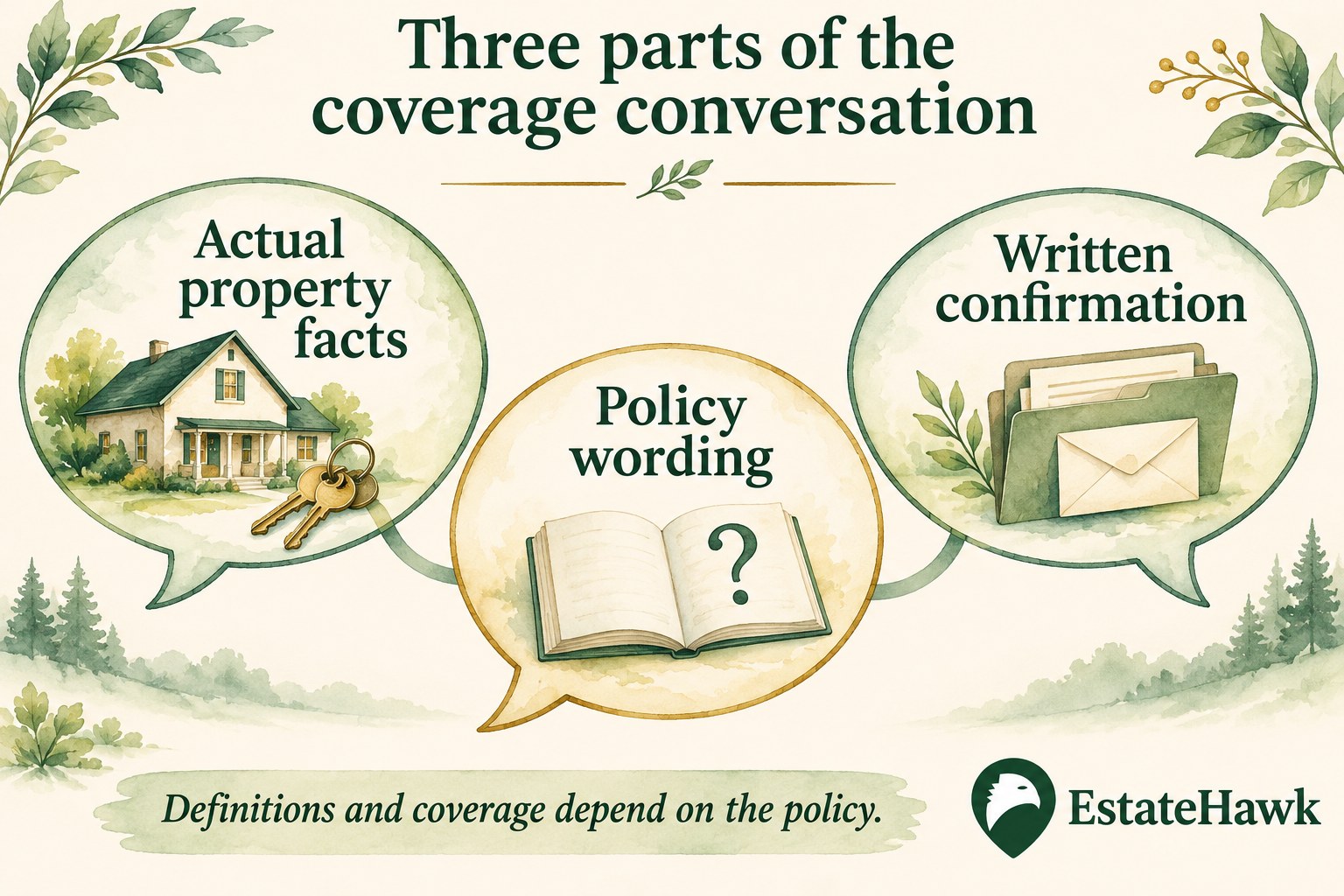
If a home is going to be vacant for more than thirty days, you must execute the proper, formal contractual route: you must notify your insurance agent or insurer in writing and secure a formal Vacant Home Insurance Policy or purchase a Vacant Home Endorsement attached to your existing policy.
Now consider the difference between a vacant home policy and builder's risk insurance.
This is where house flippers and DIY renovators get completely crushed.
An investor buys an empty house to renovate. They call their insurance agent, explain that the house is empty, and buy a standard vacant property insurance policy.
Then the investor hires a demolition crew. The crew starts knocking down interior walls, replacing plumbing stacks, and stripping off the roof shingles.
A worker accidentally starts a fire with a reciprocating saw, or a sudden thunderstorm tears a tarp off the exposed roof framing, causing fifty thousand dollars of structural water damage.
The investor files a claim under their vacant home policy.
The insurance company denies the claim.
Why? Because a vacant home policy covers a structure that is sitting empty, quiet, and undisturbed. It does not cover a construction site.
Active construction, demolition, framing, and remodeling introduce massive additional hazards: open flames, electrical wiring cut-ins, construction debris, heavy equipment, and commercial worker liabilities.
To cover a property that is undergoing substantial structural renovation or cosmetic remodeling, you must purchase a Builder's Risk Policy or a specialized Vacant Property Renovation Endorsement.
A builder's risk policy specifically covers property under construction, protecting building materials stored on site, covering structural collapses during framing, and providing comprehensive liability for construction-related perils.
Now consider the mandatory policy conditions and warranties that vacant home insurers require.
When you purchase a vacant property policy, the insurance company does not simply hand you coverage and walk away. The policy contains strict, affirmative warranties that you, as the property owner, must legally maintain.
First, look at freeze protection warranties.
If the property is located in a geographic region subject to freezing winter temperatures, the policy will contain an explicit heating warranty. It mandates that you must either maintain heat continuously throughout the dwelling at a minimum temperature, typically fifty-five degrees Fahrenheit, or you must completely shut off the main municipal water supply and professionally drain and winterize all domestic water lines, water heaters, and toilet tanks.
If you forget to winterize the lines, the furnace runs out of fuel, and the pipes burst, the insurance company will deny the freeze damage claim because you breached the affirmative policy warranty.
Second, look at physical inspection logs.
Many vacant property insurers require the owner or an authorized property manager to conduct physical interior and exterior inspections of the dwelling on a regular schedule, typically once every seven to fourteen days.
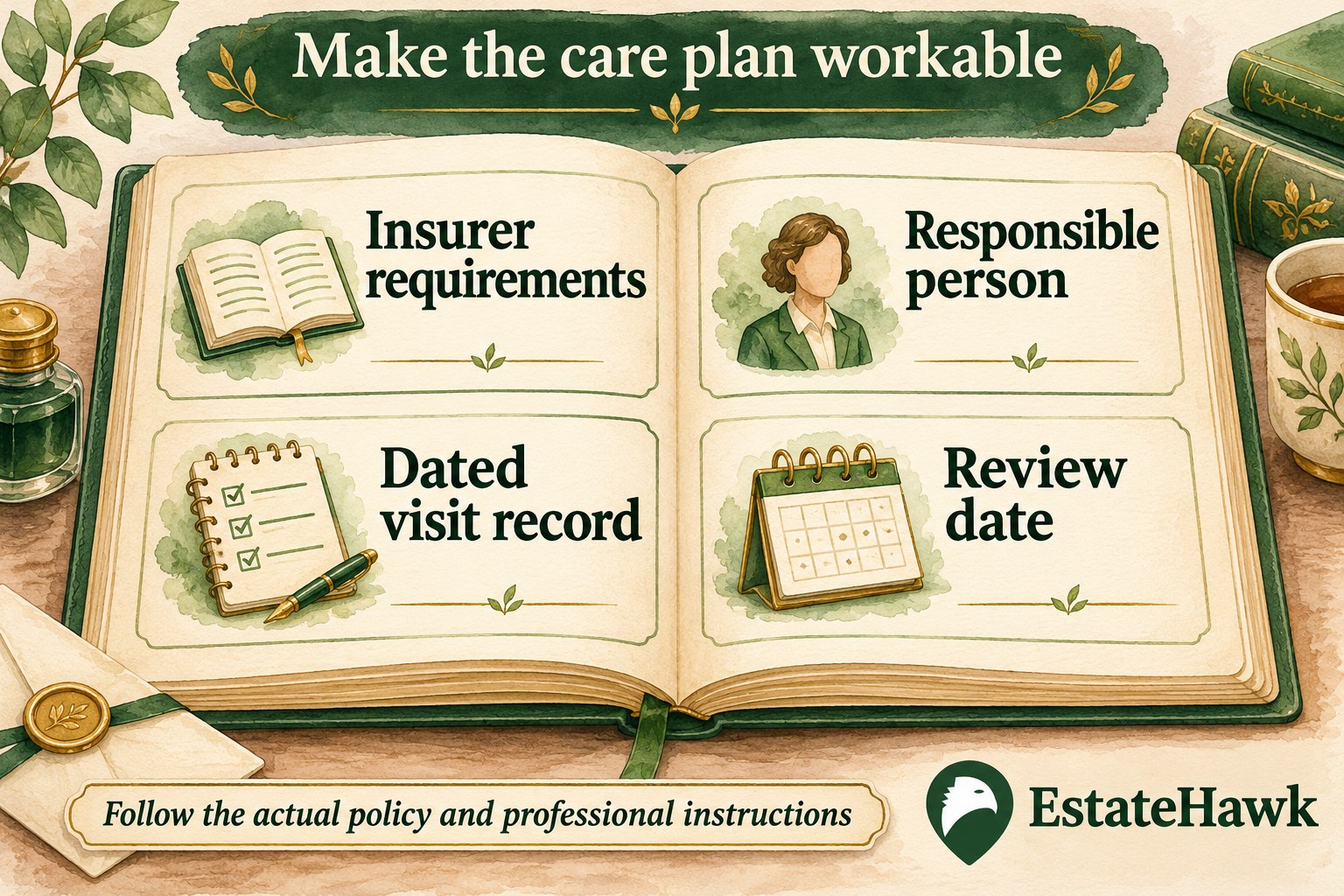
Furthermore, they require you to maintain a written inspection log detailing the date, time, inspector name, and observed condition. If a vandalism or water loss occurs, and the insurer demands your inspection log, failing to produce a contemporaneous, written record can jeopardize claim coverage.
Now look at the lender's perspective: the trap of force-placed insurance.
If the vacant home is encumbered by an active mortgage, the mortgage agreement legally requires the borrower to maintain continuous, comprehensive hazard insurance coverage acceptable to the lender.
If your standard homeowner policy cancels, non-renews, or expires because the insurance company discovered the home was vacant, the insurance company is legally required to notify the mortgage servicer.
Under federal rules enforced by the Consumer Financial Protection Bureau, the loan servicer will send formal warning notices to the borrower demanding proof of acceptable replacement insurance.
If you fail to provide proof of acceptable coverage, the loan servicer will exercise its contractual right under the deed of trust to obtain lender-placed insurance, universally known as force-placed insurance.
Force-placed insurance is an absolute financial disaster for a property owner.
As the CFPB's force-placed insurance advisories explain, lender-placed coverage carries an exorbitant premium, frequently two to four times higher than a private market policy, which the servicer charges directly to your monthly mortgage escrow account, causing your monthly payment to skyrocket.
Even worse, force-placed insurance protects exclusively the lender's financial interest in the loan balance. It provides zero coverage for your accumulated equity, zero coverage for personal property, and zero personal liability protection if a neighborhood child wanders onto the vacant property and injures themselves on a broken concrete step.
Relying on lender-placed insurance is paying four times the price for twenty percent of the protection.
Let us walk through an educational case study that demonstrates how an unverified vacancy assumption destroys an inherited property.
Consider an heir named Julian who inherits a charming single-family home on Willow Lane following the passing of his elderly aunt in late October.
The home is fully paid off, with zero mortgage debt. The house is furnished with his aunt's estate belongings.
Julian decides to sell the home. He spends November hiring an estate sale company to liquidate the furniture, clears out the pantry, and lists the house on the MLS in early December.
Julian knows that his aunt had an active homeowner insurance policy with a reputable national carrier, with annual premiums paid through the following June. Julian continues paying the utility bills and assumes the existing insurance policy will protect the house while it sits on the market awaiting a buyer.
Julian does not call the insurance agent. He does not inform the insurer that his aunt passed away. He does not inform the insurer that the home is completely vacant.
In mid-January, a severe polar vortex sweeps across the region, dropping outdoor temperatures to negative eight degrees for four consecutive days.
The ancient gas furnace in the basement suffers a mechanical thermocouple failure and shuts off completely. The interior temperature inside the vacant house drops below freezing.
An overhead half-inch copper water supply pipe running through the ceiling of the upstairs master bathroom freezes solid, expands, and splits open along a four-inch seam.
Two days later, the temperature rises above freezing. The ice inside the pipe thaws.
Municipal city water under sixty pounds of continuous pressure begins blasting out of the ruptured copper pipe at twenty gallons per minute.
Water pours through the bathroom floor, saturating the ceilings, destroying the drywall, warping the structural oak hardwood flooring throughout the main level, and flooding the finished basement with four feet of standing water.
The water runs uninterrupted for five full days until a vigilant neighbor notices water cascading off the front porch steps and calls the municipal water department to shut off the street curb valve.
Julian rushes to the property in horror. The damage is total. The restoration contractor estimates the complete structural drying, mold remediation, drywall reconstruction, and flooring replacement at $82,000.
Julian files a formal claim under his aunt's homeowner insurance policy.
The insurance company assigns a senior forensic claims adjuster.
The adjuster inspects the property. The house is completely empty of furniture. The adjuster pulls the municipal water utility records, which show that zero water had been consumed for seventy-six consecutive days prior to the pipe burst. The adjuster pulls the real estate listing history, showing the home had been listed on the MLS as a vacant, ready-to-move-in property for sixty-five days.
Ten days later, Julian receives a certified letter from the insurer.
The claim is completely denied.
The insurer cites the explicit policy language: the dwelling was vacant for more than sixty consecutive days prior to the loss, automatically triggering the total exclusion of coverage for water damage and frozen plumbing.
Julian is left with an unsellable, severely damaged house, eighty-two thousand dollars in out-of-pocket restoration expenses, and zero insurance compensation.
Julian lost eighty-two thousand dollars because he assumed that paying an insurance premium was the same thing as having the right coverage.
Now let us examine the four conversational questions that arise whenever property owners evaluate vacant home insurance.
The first question involves staging: Does leaving a few pieces of furniture or a lamp on a timer prevent an empty property from being classified as vacant?
No. That is a dangerous myth that fails under forensic scrutiny. Insurance companies and courts look at the actual totality of the circumstances: whether the dwelling is genuinely inhabited by human beings on a continuous, daily basis. Claims adjusters routinely pull municipal electric and water utility consumption records to verify residency. A house devoid of regular domestic utility consumption, food, and daily human activity will be legally classified as vacant, regardless of whether a folding chair or an automated light timer is present.
The second question concerns policy continuity: Does a standard homeowner insurance policy automatically continue protecting a home after the owner moves out or passes away, as long as the premiums are paid?
Never assume that paying a premium preserves coverage. An insurance contract is based on the underwriting representations made when the policy was written. Standard residential policies contain explicit occupancy conditions. Once a dwelling remains vacant beyond the policy's specified window, typically thirty or sixty consecutive days, the policy automatically suspends coverage for major perils like vandalism, water damage, and theft. Furthermore, if an owner passes away, the estate or heirs must formally update the named insured on the policy; an unendorsed policy may not legally protect the estate or new title holders.
The third question involves lenders: What happens if a mortgage lender discovers that a vacant home is not covered by a compliant vacant property insurance policy?
If an insurance carrier cancels or alters coverage due to vacancy, they are legally required to notify the mortgage servicer. The lender will issue statutory warning notices under CFPB regulations demanding that you provide proof of acceptable coverage. If you fail to respond, the lender will purchase force-placed insurance. Force-placed insurance costs two to four times more than traditional coverage, is billed directly to your monthly mortgage payment, and protects exclusively the lender's debt balance, leaving your accumulated home equity and personal liability completely uninsured.
The fourth question addresses technology: Where do modern property intelligence platforms and public record data fit into vacant property risk management?
Property intelligence platforms are valuable discovery mechanisms for tracking property transitions, checking tax assessment dockets, and reviewing ownership transfers. However, software platforms cannot verify whether a heating system is actively functioning, confirm that water lines are properly drained, or review specific endorsement language in an insurance contract. Managing vacant property risk requires direct, transparent communication with a licensed insurance agent, written policy endorsements, and regular physical inspections of the dwelling.
When you leave a property vacant, approach insurance with uncompromising discipline.
Never conceal the property's status from your insurer. Contact your licensed insurance agent immediately, disclose the exact date of vacancy, and obtain a formal written Vacant Home Policy or Vacant Dwelling Endorsement. Maintain your heating warranties, document your regular physical walk-throughs, and ensure that your property is genuinely protected.
That level of risk management discipline is what protects your equity, preserves your capital, and ensures that an empty house does not turn into a financial catastrophe.