
Earnest Money: Deposits, Refund Questions and Closing Credit
Separate the deposit promise, proof of receipt, refund rights and closing credit. A clear payment trail helps you ask the right questions before committing funds.
 By EstateHawk
On this page

Let's talk about the act of wiring five thousand dollars to a stranger. If you listen to casual homebuying advice, your first tip when making an offer on a house is almost always to write a nice, earnest check to prove you are a serious human being.
Who would have thought?
Show up with a few thousand dollars of good faith money, hand it over with a warm smile, and rest easy knowing that if anything goes wrong, you can simply ask for your check back like you're returning a sweater to a department store. Truly breathtaking transactional innocence. So elegant in its simplicity. So exquisitely horrifying when you discover three weeks into escrow that your inspection contingency deadline expired yesterday afternoon at five o'clock, the seller refuses to sign the cancellation release, and your five-thousand-dollar deposit is frozen in an escrow trust account while the seller's attorney prepares a civil claim for liquidated damages.
While we're handing out life-altering advice, let's make sure deep-sea saturation divers remember to untie their safety harnesses whenever they feel a little claustrophobic. Let's make sure high-voltage electricians remember to test live sub-station transformers by licking their fingertips.
No, "earnest money is just refundable good faith money" is advice manufactured for fake property buyers. It belongs to the retail crowd who believe real estate contracts are polite social invitations that can be canceled at any moment without financial consequence. Those people think an escrow officer is a friendly referee who immediately wires your money back the moment you send an emotional text message saying you changed your mind.
Here's what the real estate advertisements and superficial advice blogs will never explain: for an authentic escrow officer, closing attorney, or transactional litigator, managing earnest money isn't a casual administrative handshake, it's an obsession they have zero control over.
If you let an authentic closing obsessive anywhere near an earnest money ledger, their brain completely disconnects from all standard conversational pleasantries. Normal people look at a deposit receipt and feel comforted. The document obsessive could not care less about comfort. They want to know whether the contract's effective date was triggered by the final signature or the delivery of notice, whether Texas Real Estate Commission or state-specific statutory delivery deadlines require delivery within three strict business days, whether the funds are held in a segregated, interest-bearing IOLTA attorney trust account or an insured title escrow account, and whether the buyer's termination notice was delivered before the expiration of the financing contingency under rigid time-is-of-the-essence contract clauses.
In fact, if you leave that researcher unsupervised at two in the morning with an open browser, they won't even be reviewing escrow trust accounting rules at all. They will have fallen headfirst into an algorithmic rabbit hole on a Polish military vehicle restoration exchange, studying auction listings for a decommissioned Soviet BTS-4 heavy tracked armored recovery vehicle. They will spend two solid hours examining technical blueprints of its 580-horsepower V-12 diesel engine and massive front-mounted dozer blade, analyzing how its heavy-duty mechanical winch system could pull a forty-ton tank out of a freezing river swamp with a two-hundred-foot steel cable, calculating whether its wide steel track pads would chew up an asphalt highway without destroying the roadbed, and reading translated forum flame wars from 2011 about whether hydraulic winch clutch bands slip when submerged in freezing muddy water.
Then the Instant Gratification Monkey at the back of their brain gets hit with a cold shock of pure dread. The Rational Decision-Maker kicks down the door, drags them away from Soviet heavy armored recovery tractors, and slams their face back into the purchase contract. Because right there in paragraph seven is an earnest money delivery deadline that expires at five o'clock this afternoon, and the buyer has not even requested the wiring instructions from the title company.
Welcome to the strict, unforgiving legal world of Earnest Money.
The foundational trap that catches property buyers completely off guard begins with a total failure to understand what earnest money actually is in real property law.
Earnest money is not a gift.
It is not a down payment.
And it is certainly not a casual fee paid to hold a reservation.
Earnest money is a legally binding deposit delivered by a buyer into a neutral third-party escrow account pursuant to a purchase agreement.
Its primary legal function is twofold:
First, it provides tangible legal consideration to bind the executory bilateral contract.
Second, it establishes a predetermined pool of liquidated damages.
Under standard American real estate contracts, if the seller fulfills all of their obligations, delivers clear marketable title, and stands ready to close, but the buyer breaches the contract, defaults, or walks away without a valid legal excuse, the seller has the legal right to retain the earnest money deposit as full liquidated damages for the breach.
This immediately separates earnest money from the down payment.
The down payment is the total cash equity that a buyer contributes toward the purchase price on closing day, representing the difference between the mortgage loan amount and the purchase price.
Earnest money is simply an upfront deposit paid at the very beginning of the transaction.
On closing day, assuming the transaction completes successfully, your earnest money deposit does not disappear.
Under standard Consumer Financial Protection Bureau Closing Disclosure rules, your earnest money deposit appears on Page 3 of the Closing Disclosure as an explicit cash credit under the Calculating Cash to Close table.
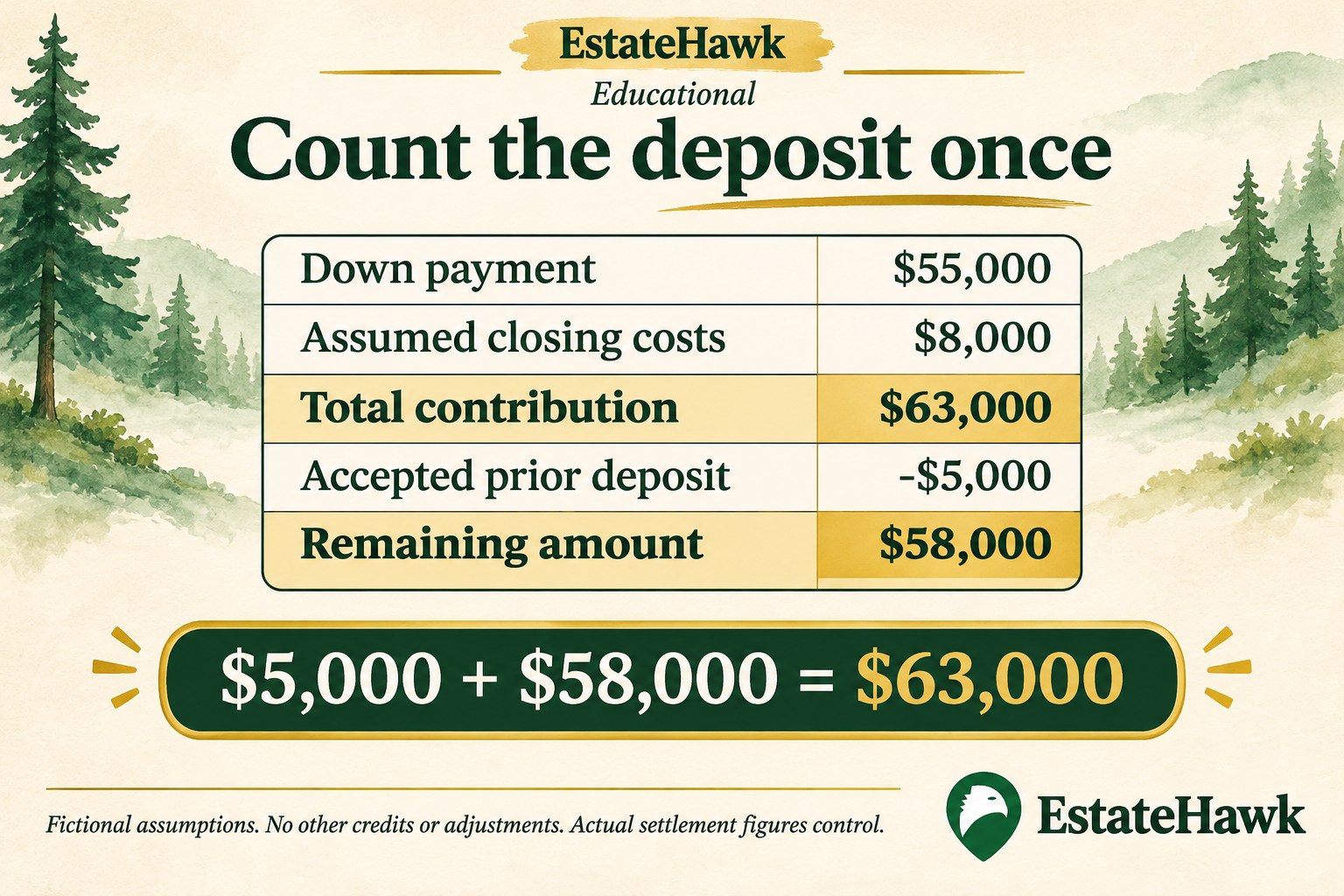
Look at the arithmetic of how earnest money is credited to prevent the double-counting error:
Suppose you contract to buy a home for $275,000.
Your mortgage lender requires a twenty percent down payment, which equals $55,000.
Your lender and title closing costs, including pre-paid property tax impounds, title insurance, and recording fees, total $8,000.
Your total gross cash requirement to complete the purchase is $63,000 ($55,000 down payment plus $8,000 closing costs).
When your offer was accepted thirty days ago, you wired a $5,000 earnest money deposit into the title company's escrow trust account.
On closing day, you do not bring $63,000 to the table.
The title company takes your $63,000 gross cash requirement and subtracts your $5,000 earnest money credit.
The remaining cash to close that you must wire on closing morning is $58,000.
Across the two payments, you contributed exactly $63,000, not $68,000. Your earnest money was an advance down payment credit, not an additional fee.
Now consider the critical legal difference between contract escrow and mortgage loan escrow.
Amateur buyers constantly confuse these two terms because the real estate industry uses the word "escrow" for two entirely unrelated mechanisms:
Contract Escrow is the temporary, neutral trust account maintained by a title company, escrow agency, or real estate brokerage trust account during the thirty to forty-five days between contract execution and closing. It exists solely to hold the buyer's earnest money deposit and closing funds under strict contractual instructions until the deed is recorded.
Mortgage Escrow, by contrast, is an ongoing impound account established by your long-term mortgage loan servicer. Every month when you pay your mortgage, the servicer collects an extra few hundred dollars to pay your annual county real estate taxes and homeowner insurance premiums on your behalf.
The initial escrow deposit listed on your loan estimate for future property taxes has zero connection to the contract earnest money you wired on day one.

Now let us examine the explosive question that triggers thousands of lawsuits every year: is earnest money refundable?
The answer is yes, but only under rigid, strictly documented contractual conditions.
Amateur buyers believe that earnest money is inherently refundable whenever they feel uncomfortable.
That is an absolute legal illusion.
Earnest money is refundable if, and only if, the buyer terminates the purchase contract in strict compliance with an explicit, written contractual contingency, before that contingency's specific expiration deadline.
Let us dissect the four core contractual contingencies that protect an earnest money deposit:
First is the Inspection Contingency, commonly referred to in Texas as the Option Period under Texas Real Estate Commission contract forms.
The inspection contingency gives the buyer a specified window of time, typically seven to ten days, to conduct independent professional home inspections, sewer scopes, roof evaluations, and structural audits.
If the buyer discovers property defects and delivers a formal, written notice of termination before the inspection contingency deadline expires, the contract is canceled, and the buyer is legally entitled to a full refund of their earnest money deposit.
However, look at what happens if the clock runs out.
In contracts governed by a strict "time is of the essence" clause, deadlines are absolute.
If your inspection contingency expires on Tuesday at 5:00 PM, and you deliver your termination notice on Tuesday at 5:08 PM, you have waived your contingency under the law. Your termination is a breach of contract, and your earnest money is forfeited.
Second is the Financing Contingency.
A financing contingency protects the buyer if their mortgage lender formally denies their loan application.
However, you cannot simply say "my loan didn't work out."
To secure an earnest money refund under a financing contingency, the contract mandates that the buyer must have made a good faith, timely loan application, provided all requested financial paperwork to the lender, and must deliver a formal, written Loan Denial Letter from an institutional underwriter prior to the financing contingency expiration date.
Third is the Appraisal Contingency.
If the property is appraised by a licensed real estate appraiser for less than the agreed purchase contract price, the appraisal contingency allows the buyer to demand that the seller lower the price to the appraised value. If the seller refuses, the buyer can terminate the contract and receive a full refund of their earnest money.
Fourth is the Title and Survey Objection Contingency.
When the title company issues the Preliminary Title Report, the buyer has a specific window of days to review Schedule B title exceptions. If the title search uncovers an unreleased second mortgage, an adverse boundary encroachment, or an unacceptable municipal easement, the buyer can submit formal title objections. If the seller cannot cure the defects within the statutory cure period, the buyer can terminate and recover their deposit.
Now let us dismantle the famous real estate myth of the three-day cooling-off period.
Folks in online forums love claiming that federal law grants all homebuyers a mandatory three-day right of rescission to cancel any real estate contract for any reason.
That is completely, dangerously false.
Under federal Truth in Lending Act regulations (Regulation Z, 12 CFR Section 1026.23), a three-day right of rescission applies strictly to refinancing a primary residence or taking out a home equity loan on a property you already own.
Federal law provides zero right of rescission or cooling-off period for the purchase of residential real estate.
As the Texas Real Estate Commission warns consumers, once a seller signs and accepts your purchase offer, you are in a legally binding contract. If you wake up the next morning with buyer's remorse and decide you do not want the house, you cannot simply cancel. Walking away without a valid contractual contingency will cost you your entire earnest money deposit.
Now consider the nightmare of the disbursement deadlock.
This is where buyers experience utter shock.
A buyer terminates a contract on day eight of a ten-day inspection contingency. The buyer's termination was timely, proper, and fully authorized by the contract.
The buyer expects the title company to wire their five-thousand-dollar deposit back to their checking account that afternoon.
The title company refuses.
Why?
Because under state escrow laws, an escrow agent is an independent fiduciary holding funds in trust for both the buyer and the seller.
An escrow officer is not a judge. An escrow officer does not have the legal authority to determine who breached the contract.
To disburse earnest money from an escrow trust account, the escrow officer must receive one of two things:
Requirement One: A formal, written Cancellation and Mutual Release of Earnest Money agreement, signed and authorized by BOTH the Buyer and the Seller.
Requirement Two: A formal, certified court order signed by a judge.
If the seller is furious that the transaction collapsed, the seller can simply refuse to sign the release form.
The seller says: "I don't care about your inspection report. I took my house off the market for two weeks. I am not signing the release."
The moment the seller refuses to sign, the escrow agent must freeze the funds.
The earnest money sits locked in the title company's trust account for weeks or months.
If the parties cannot reach a negotiated settlement, the title company will eventually file an Interpleader Action in county court. The title company deposits the money with the clerk of court, subtracts their legal fees from your deposit, and walks away, forcing the buyer and seller to hire attorneys and litigate over who gets the remaining cash.
Let us walk through an educational case study that demonstrates how an unverified earnest money timeline destroyed a buyer's deposit.
Consider a homebuyer named Tyler who contracts to purchase an attractive suburban home on Willowbrook Court for $380,000.
Tyler deposits $10,000 in earnest money with a local title company.
Tyler's purchase contract contains a standard ten-day property inspection contingency. The contract includes an explicit clause stating: "Time is of the essence in the performance of all obligations."
The contract effective date is formally established on Monday, May 4.
Under the contract's calendar rules, day ten of the inspection contingency is Thursday, May 14, at 5:00 PM.
Tyler hires a general home inspector who examines the property on May 8. The inspector flags an aging twenty-year-old roof and an older HVAC unit that uses phased-out R-22 refrigerant.
Tyler spends several days gathering contractor bids to replace the roof and HVAC, which total eighteen thousand dollars.
On Friday morning, May 15, at 9:00 AM, Tyler emails the seller's real estate agent.
Tyler writes: "We received bids for the roof and HVAC totaling $18,000. The seller must credit us $18,000 at closing, or we hereby terminate the contract and demand the return of our $10,000 earnest money deposit."
The seller's attorney responds with icy legal precision.
The seller's attorney points out that Tyler's ten-day inspection contingency expired yesterday afternoon, Thursday, May 14, at precisely 5:00 PM.
Because Tyler failed to deliver a written termination notice or a signed repair addendum before the 5:00 PM deadline, Tyler's inspection contingency expired by operation of law.
Under the explicit contract terms, Tyler accepted the property in its present as-is condition.
Tyler's email on Friday morning was an unauthorized refusal to close, constituting an immediate anticipatory breach of contract.
Tyler panics and hires a litigation attorney.
Tyler's attorney reviews the file and delivers the painful truth: because the contract contained a strict time-is-of-the-essence clause, missing the deadline by sixteen hours was fatal.
The seller formally terminates the contract for buyer default and demands the $10,000 earnest money deposit as liquidated damages.
The title company freezes the funds. Tyler is forced to sign a settlement release forfeiting seven thousand dollars of his deposit to the seller to avoid being sued for additional damages, while paying fifteen hundred dollars in legal fees.
Tyler lost eight thousand five hundred dollars because he failed to track his inspection deadline on a calendar.
Now let us examine the four conversational questions that constantly arise whenever property buyers manage earnest money.
The first question involves financial accounting: Is earnest money an additional fee paid on top of the mortgage down payment?
No. That is a common accounting misunderstanding. Earnest money is an upfront advance deposit that is fully credited toward your total cash to close on the final settlement statement. On closing day, the title company takes your total required cash, which includes your down payment and closing costs, and subtracts your earnest money deposit. Your earnest money is applied directly toward your purchase, ensuring you never pay that money twice.
The second question concerns cooling-off periods: Does a homebuyer have an automatic three-day statutory right to cancel a contract and receive a full deposit refund?
Never assume that. A three-day right of rescission under federal law applies exclusively to refinancing or home equity lines of credit on an existing primary residence, not the purchase of residential real estate. Once a seller accepts your purchase contract, the agreement is legally binding. You cannot cancel the contract simply because of buyer's remorse. A refund of earnest money requires strict compliance with an explicit contractual contingency, such as an inspection, financing, or appraisal contingency, exercised prior to the contract deadline.
The third question involves escrow disputes: What happens when an angry seller refuses to sign the earnest money release form?
If a seller refuses to sign a mutual cancellation and release agreement, the escrow agent cannot disburse the funds to either party. Under state escrow regulations, an escrow officer must remain neutral and cannot resolve disputed factual claims. The earnest money remains frozen in the escrow trust account. If the parties cannot reach a negotiated compromise, the title company will file an interpleader lawsuit, transferring the money to the county court registry, where legal fees will be deducted from the deposit before a judge determines the rightful recipient.
The fourth question addresses technology: Where do modern property intelligence platforms and automated workflow tools fit into earnest money tracking?
Property intelligence software platforms are invaluable for preliminary due diligence, verifying legal ownership, checking recorded deeds, and analyzing parcel boundaries before submitting an offer. However, software algorithms cannot calculate state-specific contractual effective dates, interpret ambiguous contingency addenda, or track wire delivery deadlines. Managing earnest money requires active calendar tracking, professional title escrow coordination, and qualified real estate legal counsel.
When you submit earnest money on a property acquisition, approach the transaction with absolute contractual discipline.
Know your exact effective date. Mark every single contingency deadline on your calendar with alerts set forty-eight hours in advance. Verify your wire instructions through trusted, independent phone channels to prevent wire fraud, and never allow a contingency deadline to pass without a formal, written extension or a timely termination.
Operating with that level of legal and procedural rigor is what protects your capital, preserves your equity, and ensures that your good faith deposits remain safe, defensible, and fully under your control.